Miljö: miljö / Klimatzon / djupintervall / distributionsområde
Ekologi
marina bottenlevande; djupintervall 0 - 90 m (Ref. 9824). Tropical
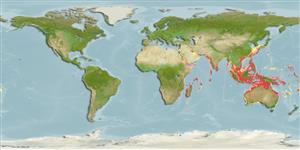
Indo-West Pacific: India and off Sri Lanka eastward to the Philippines and the northeastern coast of Australia. Range extends to Okinawa Island, Japan. Also known from the Persian Gulf (Ref. 5999).
Storlek / Vikt / Ålder
Könsmognad: Lm ? range ? - ? cm
Max length : 21.0 cm TL hane/ej könsbestämd; (Ref. 9824); common length : 17.0 cm TL hane/ej könsbestämd; (Ref. 9824)
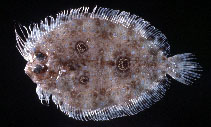
Taggstrålar i ryggfenan (totalt) : 0; Mjukstrålar i ryggfenan (totalt) : 77 - 86; Taggstrålar i analfenan: 0; Mjukstrålar i analfenan: 61 - 71. Eyed side pale brownish, with 3 large, prominent dark ocelli, 1 each above and below pectoral fin, 1 on middle of straight section of lateral line. Head and body with many small, distinct, dark spots and obscure markings along dorsal and ventral body margins. Males with 2 distinct dark markings above upper eye. Dorsal, anal, and pelvic fins on eyed side with indistinct dusky spots and markings. Caudal fin with a pair of marks behind fin base. Pectoral fin on eyed side with broad pale cross bars. Blind side pale. Body deeply ovoid, its depth 1.5 to 1.8 times in SL. Head moderately large, snout shorter than eye, profile deeply notched ahead of interorbital area. Head length3.5 to 4 times in SL. Interorbital region concave, narrow in both sexes. Both eyes on left side of head, front margin of upper eye slightly behind front margin of lower eye. Mouth moderate in size, reaching to or slightly beyond anterior margin of lower eye, length of upper jaw 2.8 to 3.4 times in head length. Teeth in both jaws uniserial. Teeth in upper jaw becoming gradually smaller posteriorly. Teeth of lower jaw about equal in size, similar to anterior teeth of upper jaw. Scales on eyed side ctenoid. Scales on blind side cycloid. Lateral line on both sides of body (Ref 42535).
Body shape (shape guide): short and / or deep.
Found in shallow mud, sand, and rubble bottoms of the continental shelf (Ref. 9824). Feeds on benthic animals. Marketed fresh and used in making fish meal (Ref. 9824).
Livscykel och parningsbeteende
Könsmognad | Reproduktion | Lek | Ägg | Fekunditet | Larver
Nielsen, J.G., 1974. Bothidae. In W. Fisher and P.J.P. Whitehead (eds.) FAO species identification sheets for fishery purposes. Eastern Indian Ocean (fishing area 57) and Western Central Pacific (fishing area 71). Rome, FAO, vol. 3. pag. var. (Ref. 4896)
Status på IUCN:s rödlista (Ref. 130435: Version 2025-2 (Global))
Hot mot människor
Harmless
Mänskliga användningsområden
Fiskeri: kommersiell
Verktyg
Särskilda rapporter
Ladda ner XML
Internet-källor
Uppskattningar baserade på modeller
Önskad temperatur (Ref.
123201): 24.5 - 29, mean 28 °C (based on 1708 cells).
Index för fylogenetisk mångfald (Ref.
82804): PD
50 = 0.6250 [Uniqueness, from 0.5 = low to 2.0 = high].
Bayesian length-weight: a=0.00912 (0.00526 - 0.01582), b=2.97 (2.82 - 3.12), in cm total length, based on LWR estimates for this species & (Sub)family-body (Ref.
93245).
Trofisk nivå (Ref.
69278): 3.6 ±0.0 se; based on diet studies.
Resiliens (Ref.
120179): Mellan, lägsta populationsfördubblingstid 1,4-4,4 år (Preliminary K or Fecundity.).
Sårbarhet i fisket (Ref.
59153): Low vulnerability (11 of 100).
🛈
Näringsämnen (Ref.
124155): Calcium = 191 [86, 366] mg/100g; Iron = 1.17 [0.56, 2.11] mg/100g; Protein = 17.1 [15.8, 18.5] %; Omega3 = 0.141 [0.065, 0.291] g/100g; Selenium = 49.2 [21.8, 112.6] μg/100g; VitaminA = 34.9 [9.0, 136.7] μg/100g; Zinc = 1.07 [0.67, 1.62] mg/100g (wet weight);