Classificazione / Nomi
Nomi Comuni | Sinonimi | Catalog of Fishes(Genere, Specie) | ITIS | CoL | WoRMS | Cloffa
>
Cyprinodontiformes (Rivulines, killifishes and live bearers) >
Rivulidae (Rivulines) > Rivulinae
Etymology: parlettei: Named for Casey Parlette, who collected the type specimens.
Eponymy: Casey Parlette (d: 1979) is an American sculptor and jewellery maker and, at heart, a naturalist. [...] (Ref. 128868), visit book page.
Ambiente: milieu / zona climatica / distribuzione batimetrica / gamma di distribuzione
Ecologia
; acqua dolce pelagico; pH range: 7.0 - ?. Tropical; 25°C - ?
South America: currently known only from the type locality, a small stream belonging to the río Araza in the vicinity of Vitobamba in Departamento Cusco, south eastern Peru.
Dimensione / Peso / Età
Maturità: Lm ? range ? - ? cm
Max length : 3.8 cm SL maschio/sesso non determinato; (Ref. 88925)
Breve descrizione
Chiavi di identificazione | Morfologia | Morfometria
Raggi dorsali molli (totale) : 8 - 9; Raggi anali molli: 13 - 14; Vertebre: 30. Males of Rivulus parlettei differs from males of other members of the R. limoncochae group by having irregular interrupted lines of dots wider than the interspaces (vs. longitudinal rows of dots, sometimes coalescing to form stripes narrower than the interspaces), by an inferior lip without distinctive colouration (vs. red inferior lip), a dorsal and anal fin without a dark posterior tip (vs. presence of dark tip), a light blue venter (vs. yellow in R. christinae and white in the remaining species of R. limoncochae group) and a yellowish anal fin with a whitish basal region (vs. yellow with light blue basal region). Females of R. parlettei can be diagnosed from females of the other species of the R. limoncochae by the presence of variable shaped orange spots on body sides (mainly above anal fin) forming oblique bars (vs. absence of spots or spots forming stripes), by a yellow-orange ventral parts of head, venter and caudal peduncle (vs. light blue to light brown) and by having orange to yellow paired fins (vs. yellowish hyaline or hyaline paired fins). This species can be further distinguished by the position of its dorsal-fin origin (dorsal fin origin above base of 7th or 8th of anal-fin ray ( vs. 9th or 12th anal-fin ray in R. christinae, R. erberi, R. iridescens, R. rubrolineatus, and R. taeniatus) (Ref. 88925).
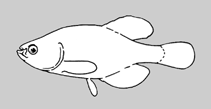
Body shape (shape guide): elongated.
Found in a small forest stream and in an adjacent shallow pool with clear and transparent water and with mud and leaf litter on its ground (Ref. 88925).
Ciclo vitale e comportamento di accoppiamento
Maturità | Riproduzione | Deposizione | Uova | Fecondità | Larve
Valdesalici, S. and I. Schindler, 2011. Description of a new killifish of the genus Rivulus (Teleostei: Cyprinodontiformes: Rivulidae) from south eastern Peru. Vertebrate Zoology 61(3):313-320. (Ref. 88925)
Stato della Lista Rossa IUCN (Ref. 130435: Version 2025-2 (Global))
Minaccia per l'uomo
Harmless
Usi umani
Strumenti
Rapporti speciali
Scarica XML
Fonti Internet
Stime basate su modelli
Indice di diversità filogenetica (Fonte Biblio.
82804): PD
50 = 0.5000 [Uniqueness, from 0.5 = low to 2.0 = high].
Bayesian length-weight: a=0.00912 (0.00375 - 0.02219), b=3.11 (2.93 - 3.29), in cm total length, based on LWR estimates for this Genus-body shape (Ref.
93245).
Livello trofico (Fonte Biblio.
69278): 3.2 ±0.4 se; based on size and trophs of closest relatives
Vulnerabilità della pesca (Ref.
59153): Low vulnerability (10 of 100).
🛈