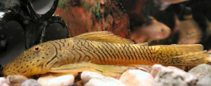
>
Siluriformes (Catfishes) >
Loricariidae (Armored catfishes) > Hypostominae
Etymology: Chaetostoma: Greek, chaite = hair + Greek, stoma = mouth (Ref. 45335); formosae: This species is named formosae, an adjective in genitive case derived from the latin formosa. The name honours my sister, Laura María Ballen, in recognition of her unconditional love and support to me.
Môi trường: môi trường / vùng khí hậu / Mức độ sâu / phạm vi phân phối
Sinh thái học
; nước ngọt gần đáy. Tropical
South America: Colombia. Known from western piedmont tributaries of the upper río Meta and Guaviare basins, in departments of Meta and Casanare, Eastern Colombia, Orinoco drainage (ref. 88853).
Bộ gần gũi / Khối lượng (Trọng lượng) / Tuổi
Chín muồi sinh dục: Lm ? range ? - ? cm
Max length : 9.7 cm SL con đực/không giới tính; (Ref. 88853)
Mô tả ngắn gọn
Khóa để định loại | Hình thái học | Sinh trắc học
Chaetostoma formosae differs from all the species currently in Chaetostoma with the exception of Chaetostoma anale and Chaetostoma jegui by the presence in mature males of an enlarged second unbranched anal-fin ray bearing two distinct posterior dermal folds, and reaching the base of the caudal fin when fully developed. Chaetostoma formosae differs from C. anale in having an angular distal pelvic-fin margin in mature males (vs. W-shaped distal margin in mature C. anale males and the leading pelvic-fin ray neither elongate nor filamentous, not reaching beyond the adjacent branched ray in mature males (vs. leading pelvic-fin ray both enlarged and filamentous, longer than the remaining rays in mature males of C. anale). Chaetostoma formosae differs from C. jegui in having dark spots restricted to the head and the dorsal region surrounding the dorsal-fin base, and with compound pterotic and lateral plates bordered by dark pigment (vs. dark background with light blotches in C. jegui); and by the shape of the distal margin of the pelvic fin strongly projected and angular in mature males, vs. distal margin straight and with leading-fin ray sometimes surpassing the distal margin of the fin as evident in photographs) (Ref. 88853).
Body shape (shape guide): elongated.
Facultative air-breathing in the genus (Ref. 126274)
Vòng đời và hành vi giao phối
Chín muồi sinh dục | Sự tái sinh sản | Đẻ trứng | Các trứng | Sự sinh sản | Ấu trùng
Ballen, G.A., 2011. A new species of Chaetostoma Tschudi (Siluriformes: Loricariidae) from Colombia with a definition of the C. anale species group. Papéis Avulsos de Zoologia 51(26):383-398. (Ref. 88853)
Tình trạng Sách đỏ IUCN (Ref. 130435: Version 2025-2 (Global))
Mối đe dọa đối với con người
Harmless
Sử dụng của con người
Các công cụ
Báo cáo đặc biệt
Tải xuống XML
Các nguồn internet
Ước tính dựa trên mô hình
Chỉ số đa dạng phát sinh loài (Tài liệu tham khảo
82804): PD
50 = 0.5000 [Uniqueness, from 0.5 = low to 2.0 = high].
Bayesian length-weight: a=0.01660 (0.00737 - 0.03739), b=2.95 (2.77 - 3.13), in cm total length, based on LWR estimates for this Genus-body shape (Ref.
93245).
Sự dễ bị tổn thương của nghề đánh cá (Ref.
59153): Low vulnerability (10 of 100).
🛈