Classificazione / Nomi
Nomi Comuni | Sinonimi | Catalog of Fishes(Genere, Specie) | ITIS | CoL | WoRMS | Cloffa
>
Cichliformes (Cichlids, convict blennies) >
Cichlidae (Cichlids) > Pseudocrenilabrinae
Etymology: Cynotilapia: Greek, kyon = dog + Bechuana, African native thiape = fish (Ref. 45335); aurifrons: From latin auri = gold, and frons = brow, in reference to frontal coloration in males; this name is preferred to the widely used 'Mbamba' - given as an informal name by Ribbink et al. (1983) -, because it refers to Mbamba Islet, near Likoma Island on the central eastern coast, far from that of the type material, which comes from the northwestern coast; specimens from Mbamba Islet may prove later to represent a different subspecies, then the name 'Mbamba' would remain available (Ref. 88848).
Ambiente: milieu / zona climatica / distribuzione batimetrica / gamma di distribuzione
Ecologia
; acqua dolce benthopelagico. Tropical
Africa: Lake Malawi (Ref. 88848).
Dimensione / Peso / Età
Maturità: Lm ? range ? - ? cm
Max length : 7.3 cm SL maschio/sesso non determinato; (Ref. 88848)
Breve descrizione
Chiavi di identificazione | Morfologia | Morfometria
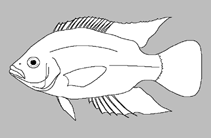
Spine dorsali (totale) : 15 - 17; Raggi dorsali molli (totale) : 8 - 10; Spine anali: 3; Raggi anali molli: 7 - 8. Diagnosis: This species of Microchromis is characterized by a blue-white pattern with dark vertical bars on body, enhanced in dominant specimens, where these bars almost hide the underlying colour; bars sometimes slightly extending onto dorsal fin; similar to the Maylandia zebra species group, with which they share the same overall colouration; differs from these mainly by dentition: teeth on outer rows short and conical, regularly decreasing in size from symphysis to corner, vs. bicuspid in Maylandia (Ref. 88848). It differs from Microchromis zebroides by its heavily black pattern and melanic pattern not extending onto brow, which shows a brilliant blue to yellow hue, according to the locality; dorsal fin yellow, with black submarginal band and whitish marginal band (Ref. 88848).
Body shape (shape guide): fusiform / normal.
Ciclo vitale e comportamento di accoppiamento
Maturità | Riproduzione | Deposizione | Uova | Fecondità | Larve
Li, S., A.F. Konings and J.R. Stauffer Jr., 2016. A revision of the Pseudotropheus elongatus species group (Teleostei: Cichlidae) with description of a new genus and seven new species. Zootaxa 4168(2):353-381. (Ref. 119465)
Stato della Lista Rossa IUCN (Ref. 130435: Version 2025-2 (Global))
Minaccia per l'uomo
Harmless
Usi umani
Strumenti
Rapporti speciali
Scarica XML
Fonti Internet
Stime basate su modelli
Indice di diversità filogenetica (Fonte Biblio.
82804): PD
50 = 0.5312 [Uniqueness, from 0.5 = low to 2.0 = high].
Bayesian length-weight: a=0.00389 (0.00180 - 0.00842), b=3.12 (2.94 - 3.30), in cm total length, based on all LWR estimates for this body shape (Ref.
93245).
Livello trofico (Fonte Biblio.
69278): 3.4 ±0.4 se; based on size and trophs of closest relatives
Vulnerabilità della pesca (Ref.
59153): Low vulnerability (10 of 100).
🛈