>
Cypriniformes (Carps) >
Sundadanionidae (Tiny danios)
Etymology: Sundadanio: Sunda: Asiatic island; Danio: from ‘dhani’, local Bengali/Bangla name for small minnows (Ref. 2031); gargula: Derived from gar-, an onomatope common to many ancient European language for boiling water or water flowing through a gullet, and from the Latin 'gula', meaning throat; this gave rise to French gargouille and the English gargoyle; in reference to the somewhat grotesque appearance of the head and throat of tuberculate males of this species. A noun in apposition.
More on authors: Conway, Kottelat & Tan.
Ambiente: milieu / zona climática / intervalo de profundidade / gama de distribuição
Ecologia
; Água doce demersal. Tropical
Asia: Bangka Island, Sumatra, Indonesia.
Tamanho / Peso / Idade
Maturidade: Lm ? range ? - ? cm
Max length : 1.9 cm SL macho/indeterminado; (Ref. 88800)
Descrição breve
Chaves de identificação | Morfologia | Morfometria
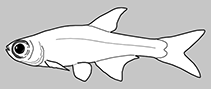
Raios dorsais moles (total) : 9; Raios anais moles: 9; Vértebras: 34. Distinguished all its congeners by the greater distance between the dark lateral stripe and the
ventral midline in males (13.5-14.5 % SL vs. 8.7- 13.6) and by its larger and more numerous tubercles (enlarged scales next to window in body musculature with a vertical row of 3-5 large
conical tubercles vs. 1-3; scales posterior to enlarged scales next to window in body musculature and anterior to anal-fin origin with 2 large, closely situated conical tubercles at center vs. 1 or 2 small, widely spaced tubercles). Can be further distinguished by the following combination of characters: large adult body size (largest specimen examined 19.0 mm SL, smallest tuberculate male 15.2 mm SL); live males with blue to emerald green sheen present across dorsal body surface and an intense red colour across anterior portion of anal fin; preserved males with a highly developed dark lateral stripe of uniform intensity along its entire length, horizontal through ventral border of which, when brought forward, extends through dorsal half of eye; absence of secondary lateral stripe in preserved males; absence of reticulate pattern along dorsal body surface; absence of dusky markings on dorsal and
caudal fins; complete covering of scales on caudal peduncle (Ref. 88800).
Body shape (shape guide): fusiform / normal.
Inhabits peat swamp forests (Ref. 88800).
Ciclo de vida e comportamento de acasalamento
Maturidade | Reprodução | Desova | Ovos | Fecundidade | Larvas
Conway, K.W., M. Kottelat and H.H. Tan, 2011. Review of the Southeast Asian miniature cyprinid genus Sundadanio (Ostariophysi: Cyprinidae) with descriptions of seven new species from Indonesia and Malaysia. Ichthyol. Explor. Freshwat. 22(3):251-288. (Ref. 88800)
Categoria na Lista Vermelha da IUCN (Ref. 130435: Version 2025-2 (Global))
Vulnerável (VU) (B1ab(i,ii,iii)+2ab(i,ii,iii)); Date assessed: 04 January 2019
Ameaça para o homem
Harmless
Utilização humana
Pescarias: sem interesse
Ferramentas
Relatórios especiais
Descarregue XML
Fontes da internet
Estimativas baseadas em modelos
Índice de diversidade filogenética (Ref.
82804): PD
50 = 0.5059 [Uniqueness, from 0.5 = low to 2.0 = high].
Bayesian length-weight: a=0.01122 (0.00514 - 0.02450), b=3.04 (2.87 - 3.21), in cm total length, based on all LWR estimates for this body shape (Ref.
93245).
Nível Trófico (Ref.
69278): 3.0 ±0.2 se; based on size and trophs of closest relatives
Vulnerabilidade da pesca (Ref.
59153): Low vulnerability (10 of 100).
🛈