>
Tetraodontiformes (Puffers and filefishes) >
Monacanthidae (Filefishes)
Etymology: Cantherhines: Greek, kanthos = the outer or inner corner of the eye, where the lids meet, 1646 + Greek, rhinos = nose (Ref. 45335).
More on author: Rüppell.
Ambiente: milieu / zona climatica / distribuzione batimetrica / gamma di distribuzione
Ecologia
marino associati a barriera corallina; distribuzione batimetrica 0 - 20 m (Ref. 9710). Tropical; 32°N - 32°S
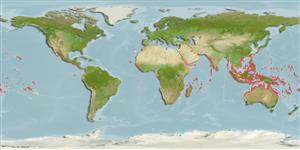
Eastern Atlantic: Gulf of Guinea, Annobon Islands to south coast of Africa (Ref. 3592). Indo-Weat Pacific: South Africa to Red Sea (Ref. 4421) and east to southern Japan and southeastern Oceania. Replaced by Cantherhines sandwichiensis (Quoy & Gaimard 1824) in the Hawaiian Islands (Ref. 37816).
Dimensione / Peso / Età
Maturità: Lm ? range ? - ? cm
Max length : 25.0 cm TL maschio/sesso non determinato; (Ref. 3592); common length : 15.0 cm TL maschio/sesso non determinato; (Ref. 3467)
Breve descrizione
Chiavi di identificazione | Morfologia | Morfometria
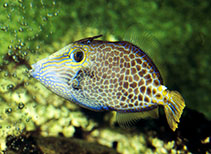
Spine dorsali (totale) : 2; Raggi dorsali molli (totale) : 32 - 36; Spine anali: 0; Raggi anali molli: 29 - 32. Can adopt three basic color patterns: mottled grey and brown, dark brown, or grey with a network of close-set polygonal spots. All have a small white spot at the rear base of the second dorsal fin and sometimes the anal fin.
Body shape (shape guide): short and / or deep.
Occurs on outer reef slopes to depths of 2 to more than 20 m (Ref. 1602, 48637), often silty habitats. Young float with loose surface weeds and adults are often with large Sargassum rafts during the wet season (Ref. 48637). Solitary. Feeds on benthic organisms (Ref. 30573). Somewhat secretive (Ref. 9710). Minimum depth reported taken from Ref. 128797.
Ciclo vitale e comportamento di accoppiamento
Maturità | Riproduzione | Deposizione | Uova | Fecondità | Larve
Randall, J.E., G.R. Allen and R.C. Steene, 1990. Fishes of the Great Barrier Reef and Coral Sea. University of Hawaii Press, Honolulu, Hawaii. 506 p. (Ref. 2334)
Stato della Lista Rossa IUCN (Ref. 130435: Version 2025-2 (Global))
Minaccia per l'uomo
Harmless
Usi umani
Pesca: scarso interesse commerciale
Strumenti
Rapporti speciali
Scarica XML
Fonti Internet
Stime basate su modelli
Temperatura preferita (Fonte Biblio.
123201): 24.7 - 29.3, mean 28.2 °C (based on 3455 cells).
Indice di diversità filogenetica (Fonte Biblio.
82804): PD
50 = 0.5002 [Uniqueness, from 0.5 = low to 2.0 = high].
Bayesian length-weight: a=0.01585 (0.00922 - 0.02724), b=2.93 (2.78 - 3.08), in cm total length, based on LWR estimates for this species & (Sub)family-body (Ref.
93245).
Livello trofico (Fonte Biblio.
69278): 3.5 ±0.37 se; based on food items.
Resilienza (Fonte Biblio.
120179): Medio, tempo minimo di raddoppiamento della popolazione 1.4 - 4.4 anni (Preliminary K or Fecundity.).
Vulnerabilità della pesca (Ref.
59153): Low vulnerability (15 of 100).
🛈
Nutrienti (Ref.
124155): Calcium = 34.3 [10.0, 108.2] mg/100g; Iron = 0.832 [0.283, 2.230] mg/100g; Protein = 18.3 [16.1, 20.5] %; Omega3 = 0.0798 [, ] g/100g; Selenium = 36.1 [13.8, 97.3] μg/100g; VitaminA = 68.3 [19.9, 238.4] μg/100g; Zinc = 1.69 [0.77, 2.96] mg/100g (wet weight); based on
nutrient studies.