>
Eupercaria/misc (Various families in series Eupercaria) >
Labridae (Wrasses) > Julidinae
Etymology: Stethojulis: Greek, stetho, stethion = brest; literal = to prick a little breast + Greek, ioulis, a fish dealing with genera Coris or Thalassoma (Ref. 45335).
More on author: Bleeker.
Umwelt: Milieu / Klimazone / Tiefenbereich / Verbreitungsgebiet
Ökologie
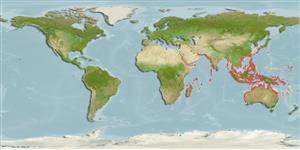
seewasser riff-verbunden; tiefenbereich ? - 18 m (Ref. 90102). Tropical; 35°N - 33°S, 32°E - 168°E
Indo-West Pacific: Persian Gulf (Ref.80050); Red Sea and East Africa to Papua New Guinea, south to Lord Howe Island. Unknown from Micronesia.
Größe / Gewicht / Alter
Geschlechtsreife: Lm ? range ? - ? cm
Max length : 15.6 cm TL Männchen/unbestimmt; (Ref. 26587)
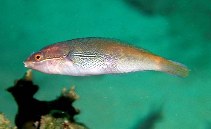
Rückenflossenstacheln (insgesamt) : 9; Rückenflossenweichstrahlen (insgesamt) : 11; Afterflossenstacheln: 3; Afterflossenweichstrahlen: 11. True form has interrupted mid-lateral stripe. Female with yellow stripe from the tip of snout to just past axil, running below eye where pale silvery-blue; male with continuous mid-lateral line and dark 'ear' (Ref. 48636).
Body shape (shape guide): fusiform / normal; Cross section: compressed.
Coastal to outer reef crests. In Japan, it is found in areas of mixed sand, rock and coral (Ref. 9710). Occurs in small groups to about 20 m depth (Ref. 48636). Feeds by sorting small animals from mouthfuls of sand and detritus.
Lebenszyklus und Paarungsverhalten
Geschlechtsreife | Fortpflanzung | Ablaichen | Eier | Fruchtbarkeit | Larven
Oviparous, distinct pairing during breeding (Ref. 205).
Randall, J.E., 2000. Revision of the Indo-Pacific labrid fishes of the genus Stethojulis, with descriptions of two new species. Indo-Pac. Fish. (31):42 p. (Ref. 36378)
IUCN Rote Liste Status (Ref. 130435: Version 2025-2 (Global))
Bedrohung für Menschen
Harmless
Nutzung durch Menschen
Fischereien: nicht kommerziell; Aquarium: Kommerziell
Tools
Zusatzinformationen
Download XML
Internet Quellen
Schätzungen auf der Grundlage von Modellen
Bevorzugte Temperatur (Ref.
123201): 24.3 - 29.2, mean 28.4 °C (based on 2808 cells).
Phylogenetischer Diversitätsindex (Ref.
82804): PD
50 = 0.5010 [Uniqueness, from 0.5 = low to 2.0 = high].
Bayesian length-weight: a=0.00977 (0.00553 - 0.01726), b=3.06 (2.91 - 3.21), in cm total length, based on LWR estimates for this species & Genus-body shape (Ref.
93245).
Trophische Ebene (Ref.
69278): 3.4 ±0.3 se; based on diet studies.
Widerstandsfähigkeit (Ref.
120179): hoch, Verdopplung der Population dauert weniger als 15 Monate. (Preliminary K or Fecundity.).
Anfälligkeit der Fischerei (Ref.
59153): Low vulnerability (10 of 100).
🛈
Nährstoffe (Ref.
124155): Calcium = 101 [60, 174] mg/100g; Iron = 0.771 [0.443, 1.442] mg/100g; Protein = 18.5 [15.6, 20.7] %; Omega3 = 0.152 [0.096, 0.245] g/100g; Selenium = 20.8 [12.1, 38.4] μg/100g; VitaminA = 150 [46, 547] μg/100g; Zinc = 1.85 [1.26, 2.92] mg/100g (wet weight);