การจำแนกประเภท / ชื่อ
ชื่อสามัญ | ชื่อพ้อง | Catalog of Fishes(สกุล, ชนิด) | ITIS | CoL | WoRMS | Cloffa
>
Ovalentaria/misc (Various families in series Ovalentaria) >
Ambassidae (Asiatic glassfishes)
Etymology: verae: Named for Vera Kasim, wife of our good friend and fish exporter Gunawan Kasim, in appreciation
of her generous assistance and logistic support (Ref. 88067).
Eponymy: Vera Kasim is the wife of a good friend of the author, Gunawan Kasim (q.v.), who is a fish exporter. She was honoured for her generous assistance and logistic support. (Also see Gunawan) (Ref. 128868), visit book page.
สิ่งแวดล้อม : สิ่งแวดล้อม / เขตภูมิอากาศ / ระดับความลึก / ระยะการกระจายสินค้า
นิเวศวิทยา
; น้ำจืด ผิวน้ำ. Tropical
Asia: Indonesia. Gymnochanda verae is currently known only from the Gantung area in the eastern part of Pulau Belitung, a large Indonesian island at the northwestern corner of the Java Sea, between the islands of Sumatra and Borneo (Ref. 88067).
ขนาด / น้ำหนัก / อายุ
วัยเจริญพันธุ์: Lm ? range ? - ? cm
Max length : 2.6 cm SL เพศผู้/กระเทย; (Ref. 88067)
คำอธิบายสั้นๆ
เครื่องมือที่ใช้ในการแยกชนิดสัตว์,สิ่งมีชีวิตออกจากกัน | สัณฐานวิทยา | ความยาวต่างๆ
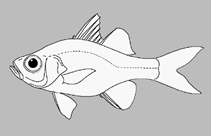
Gymnochanda verae can be differentiated from its congeners by the following characters: mature males with expanded anal and second dorsal fins, the soft rays of both fins extending to midway of the caudal fin, forming a triangular profile; the highly elongated rays of the anal and second dorsal fins joined throughout their length by the interradial membrane; up to half of the distal part of both the anal and the second dorsal fins carmine red in life (hyaline when preserved); distal half of both upper and lower caudal-fin lobes carmine red in life (hyaline when preserved); female without any elongated fin rays or colour. Gymnochanda verae also differs from its congeners apparently in having more serrae on its head: supraorbital ridge with 7 anterior serrae (vs. 0–5 anterior spines in the other species), preorbital ridge with 3 serrae (vs. 4 in G. flamea and 2 in G. limi); preopercular ridge with 7 serrae (vs. 1–4 in the other species); interopercle with 2 serrae (vs. none in G. limi and G. flamea); hind margin of preopercle with up to 9 serrae (vs. 1–5 in the other species). Information on head serrations on G. filamentosa are from Fraser-Brunner (1954: 210) and Boeseman (1957: 76), and on G. limi from Kottelat (1995: 56) (Ref. 88067).
วงจรชีวิตและพฤติกรรมการผสมพันธุ์
วัยเจริญพันธุ์ | การสืบพันธุ์ | การวางไข่ | เซลสืบพันธ์ของเพศเมีย(ไข่) | ความดกของไข่ | ตัวอ่อน
Tan, H.H. and K.K.P. Lim, 2011. A new species of glass-perch from Belitung Island, Indonesia (Teleostei: Ambassidae: Gymnochanda). Gymnochanda verae Tan & Lim, 2011. Zootaxa 3085:55-62. (Ref. 88067)
สถานะบัญชีแดงของ IUCN (Ref. 130435: Version 2025-2 (Global))
ภัยคุกคามต่อมนุษย์
Harmless
การใช้ของมนุษย์
เครื่องมือ
รายงานพิเศษ
ดาวน์โหลด XML
แหล่งที่มาจากอินเตอร์เน็ต
การประมาณค่าตามแบบจำลอง
ดัชนีความหลากหลายทางวิวัฒนาการ (อ้างอิง
82804): PD
50 = 0.5312 [Uniqueness, from 0.5 = low to 2.0 = high].
Bayesian length-weight: a=0.01175 (0.00494 - 0.02795), b=3.02 (2.82 - 3.22), in cm total length, based on LWR estimates for this (Sub)family-body shape (Ref.
93245).
ระดับชั้นอาหาร (อ้างอิง
69278): 3.1 ±0.4 se; based on size and trophs of closest relatives
ความเสี่ยงต่อการตกปลา (Ref.
59153): Low vulnerability (10 of 100).
🛈