Classificazione / Nomi
Nomi Comuni | Sinonimi | Catalog of Fishes(Genere, Specie) | ITIS | CoL | WoRMS | Cloffa
>
Siluriformes (Catfishes) >
Mochokidae (Squeakers or upside-down catfishes) > Chiloglanidinae
Etymology: Chiloglanis: Greek, cheilos = lip + Greek, glanis = a fish that can eat the bait without touching the hook; a cat fish (Ref. 45335); orthodontus: A combination of the Greek word orthos, meaning straight or erect, and the Greek word odontos, meaning tooth; this name refers to the mandibular dentition in this species, which is relatively straight and evenly spread across the dentary as compared to most other members of the genus; used as a noun in apposition (Ref. 87986).
Ambiente: milieu / zona climatica / distribuzione batimetrica / gamma di distribuzione
Ecologia
; acqua dolce benthopelagico. Tropical
Africa: several greatly separated sites in the lower Malagarasi River in Tanzania (Ref. 87986).
Dimensione / Peso / Età
Maturità: Lm ? range ? - ? cm
Max length : 2.9 cm SL maschio/sesso non determinato; (Ref. 87986)
Breve descrizione
Chiavi di identificazione | Morfologia | Morfometria
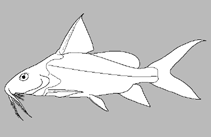
Spine dorsali (totale) : 2; Raggi dorsali molli (totale) : 5; Spine anali: 0; Raggi anali molli: 9 - 10; Vertebre: 32 - 34. Diagnosis: Chiloglanis orthodontus is a relatively small species, less than 30 mm standard length, that can be distinguished from all other Malagarasi congeners by possessing dentary teeth spread out across the mouth opening as opposed to being concentrated at the midline, and a very short dorsal spine, 4.1–7.8% of standard length vs. always greater than 8.2% (Ref. 87986). This species is further distinguished from all Lake Tanganyika region species except C. productus, by a relatively long adipose fin, 25.0–31.3% of standard length vs. less than 23.4% in all other Chiloglanis species except C. productus, which has 22.5– 26.2% (Ref. 87986). Additional features useful for distinguishing this species from other species of Chiloglanis include a relatively small oral disc, width 16.5-21.7% of standard length and length 12.1-16.3% of standard length, with relatively elongate barbels, maxillary barbel 9.4-14.8% of standard length, lateral mandibular barbel 3.8-10.7% of standard length, medial mandibular barbel 3.8-5.9% of standard length (Ref. 87986). These features and the widely spaced teeth of the lower jaw are associated with another distinctive character in this species: the shape of the lower jaw; in most species of Chiloglanis the lower jaw is similar to that found in species of Synodontis, where elongate 'S'-shaped teeth insert in a cavity on the anterior side of the dentary; in C. orthodontus the dentary tooth cup is poorly developed; the dentary teeth project from the anterodorsal surface of the dentary and are only very gently 'S'-shaped; thus far among Chiloglanis species, only Chiloglanis voltae, known from the Volta and upper Bénoué River basins in western Africa, possesses a similar jaw morphology (Ref. 87986).
Body shape (shape guide): elongated.
It is most commonly encountered in small riffles, or in peripheral regions of rapids where the water velocity is much slower (Ref. 87986).
Ciclo vitale e comportamento di accoppiamento
Maturità | Riproduzione | Deposizione | Uova | Fecondità | Larve
Friel, J.P. and T.R. Vigliotta, 2011. Three new species of African suckermouth catfishes, genus Chiloglanis (Siluriformes: Mochokidae), from the lower Malagarasi and Luiche rivers of western Tanzania. Zootaxa 3063:1-21. (Ref. 87986)
Stato della Lista Rossa IUCN (Ref. 130435: Version 2025-2 (Global))
Minaccia per l'uomo
Harmless
Usi umani
Pesca: di nessun interesse
Strumenti
Rapporti speciali
Scarica XML
Fonti Internet
Stime basate su modelli
Indice di diversità filogenetica (Fonte Biblio.
82804): PD
50 = 0.5000 [Uniqueness, from 0.5 = low to 2.0 = high].
Bayesian length-weight: a=0.00389 (0.00180 - 0.00842), b=3.12 (2.94 - 3.30), in cm total length, based on all LWR estimates for this body shape (Ref.
93245).
Livello trofico (Fonte Biblio.
69278): 3.1 ±0.4 se; based on size and trophs of closest relatives
Vulnerabilità della pesca (Ref.
59153): Low vulnerability (10 of 100).
🛈