>
Blenniiformes (Blennies) >
Blenniidae (Combtooth blennies) > Blenniinae
Etymology: Meiacanthus: Greek, meion = less = lessen + Greek, akantha = thorn (Ref. 45335); cyanopterus: The name is a combination of the Greek Kyanos (blue) and pterus (fin) in reference to the blue dorsal-fin stripe.
Περιβάλλον: περιβάλλον / κλιματική ζώνη / εύρος βάθους / εύρος διανομής
Οικολογία
Θαλασσινό(ά) Υφαλόφιλο(α); εύρος βάθους 40 - 65 m (Ref. 90102). Tropical; 8°S - 9°S
Indian Ocean: Bali. Known only from deep reef habitats. In addition to the Alor Strait localities, this species was observed by Mark Erdmann at Tulamben, off the north coast of Bali, 8°17.603'S, 115°36.599'E in 65 m.
Μέγεθος / Βάρος / Ηλικία
Γεννητική Ωρίμανση: Lm ? range ? - ? cm
Max length : 4.5 cm SL αρσενικό/απροσδιόριστο; (Ref. 87904)
Σύντομη περιγραφή
Κλείδες προσδιορισμού | Μορφολογία | Μορφομετρία
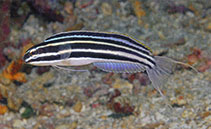
A species of Meiacanthus (subgenus Meiacanthus) with major portion of dentary gland dorsally positioned and held in place laterally by dorsolateral flange of dentary; dorsal fin IV, 25 or 26; color pattern characterized by a pair of dark mid-lateral stripes that extend onto the caudal-fin base, and another dark stripe along the dorsal body contour and dorsal-fin base that encroaches onto the fin posteriorly; dorsal fin with black submarginal stripe bordered below by pale stripe, which is blue-violet in life and best developed in males. Description. (values for the holotype are given first followed by the range of the paratypes). Dorsal fin IV, 25 (IV, 25–26). Anal fin II, 14 (II, 14–16). Pectoral fin 14-14 (13-13 to 15-15). Caudal fin: procurrent rays 4+4 (4–5+5–6); segmented rays 11, inner rays not elongated or deeply incised. Vertebrae: precaudal 12 + caudal 21 (12–13+21–22). A pair of canines posteriorly in each jaw, those in lower jaw very large with a deep frontal groove; incisor teeth in lower jaw 17 (16–17); in upper jaw 14 (15–16). Lateral line present, terminating below 5th (3–5) dorsal-fin ray; mandibular and posttemporal pores 3; single median supratemporal pore (Ref. 87904).
Body shape (shape guide): fusiform / normal.
Adults are found at depths of 40-65 m inhabiting outer reef slopes (Ref. 90102). Oviparous. Eggs are demersal and adhesive (Ref. 205), and are attached to the substrate via a filamentous, adhesive pad or pedestal (Ref. 94114). Larvae are planktonic, often found in shallow, coastal waters (Ref. 94114).
Κύκλος ζωής και συμπεριφορά ζευγαρώματος
Γεννητική Ωρίμανση | Αναπαραγωγή | Γεννοβολία | Αβγά | Γονιμότητα | Προνύμφες
Oviparous, distinct pairing (Ref. 205).
Smith-Vaniz, W.F. and G.R. Allen, 2011. Three new species of the fangblenny genus Meiacanthus from Indonesia, with color photographs and comments on other species (Teleostei: Blenniidae: Nemophini). Zootaxa 3046:39-58. (Ref. 87904)
Κατάσταση Κόκκινου Καταλόγου IUCN (Ref. 130435: Version 2025-2 (Global))
Απειλή για τον άνθρωπο
Harmless
Ανθρώπινες χρήσεις
Εργαλεία
Ειδικές εκθέσεις
Λήψη XML
Διαδικτυακές πηγές
Εκτιμήσεις βάσει μοντέλων
Δείκτης φυλογενετικής ποικιλότητας (Αναφ.
82804): PD
50 = 0.5000 [Uniqueness, from 0.5 = low to 2.0 = high].
Bayesian length-weight: a=0.01047 (0.00430 - 0.02548), b=3.08 (2.87 - 3.29), in cm total length, based on LWR estimates for this (Sub)family-body shape (Ref.
93245).
Τροφικό Επίπεδο (Αναφ.
69278): 3.3 ±0.4 se; based on size and trophs of closest relatives
Ευπάθεια στην αλιεία (Ref.
59153): Low vulnerability (10 of 100).
🛈