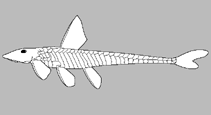
Classificatie / Namen
Lokale namen | Synoniemen | Catalog of Fishes(Genus, Soort(en)) | ITIS | CoL | WoRMS | Cloffa
>
Siluriformes (Catfishes) >
Loricariidae (Armored catfishes) > Loricariinae
Etymology: Fonchiiloricaria: Named for F. Chang, a Peruvian ichthyologist; nanodon: Name from the Greek nano, meaning reduced, and odon, meaning teeth.
Eponymy: Fonchi Ingrid Chang Matzunaga, Peruvian ichthyologist (1963–1999). (See Chang) (Ref. 128868), visit book page.
Milieu: milieu / Klimaatzone / Diepte / verspreidingsgebied
Ecologie
; zoet water demersaal. Tropical; 9°S - 10°S, 76°W - 77°W
South America: Peru.
Grootte / Gewicht / Leeftijd
Maturiteit: Lm ? range ? - ? cm
Max length : 17.5 cm mannelijk / geslacht onbekend; (Ref. 87853)
Korte beschrijving
Determinatiesleutels | Morfologie | Morfometrie
Distinguished from all other genera of Loricariinae by usually possessing one to three premaxillary teeth (although these are often missing) that are much reduced in size, particularly in comparison to the dentary teeth. The following combination of characters also differentiates this genus from all other members of the Loricariinae: lips with globular papillae on surface, except for some areas close to the opening of the mouth where the papillae are prolonged and digitiform; distal margin of lower lip with short, triangular filaments; premaxilla very reduced; the non-reduced condition of the premaxilla is represented; abdomen covered by plates, medial plates small and rhombic between lateral abdominal plates; caudal fin with 14 total rays (12 branched); orbital notch absent; five lateral series of plates; dorsal fin spinelet absent; preanal plate present, large and solid, and of irregular, polygonal shape. Trunk and caudal peduncle becoming more compressed posteriorly for last seven to 10 plates (Ref. 87853).
Body shape (shape guide): elongated.
A rheophilic species that has been collected in swift current, over rocky substrata of stones, shingle, gravel and sand of the main stream of Río Huallaga and its tributaries. The type localities are located at
600 to 700 m above sea level, between the eastern slopes of the Andean Cordillera
and the western slopes of the Cordillera Azul. In this region, the Río Huallaga is
shallow ((30-250 cm) during the dry season, but may rise to 4 m after heavy rains or during the rainy season. Huallaga River is a white water river ranging from 50-90 m width in the main channel during low water level and with dense vegetation growing along its banks. The pH, at various sites along the river where type specimens were collected, ranged from 7.3-7.6 with conductivity from 250-432 μS cm−1. The Río Monzón, next to the bridge located 7 km upstream of Tingo Maria (MUSM 38338 and MHNG 2710.048 were collected), is a
clear water river with 50 cm of visibility and with sandy areas and pebbles along
the shore. Rheophilic fauna collected together with some of the specimen were Chaetostoma, Hypostomus, Lamontichthys, Spatuloricaria, Ancistrus, Farlowella, Pimelodella, Centromochlus, Parodon, Hemibrycon, Knodus and Eigenmannia (Ref. 87853).
Levenscyclus en paargedrag
Maturiteit | Voortplanting | Paaien | Eieren | Fecunditeit | Larven
Rodriguez, M.S., H. Ortega and R. Covain, 2011. Intergeneric phylogenetic relationships in catfishes of the Loricariinae (Siluriformes: Loricariidae), with the description of Fonchiiloricaria nanodon: a new genus and species from Peru. J. Fish Biol. (Ref. 87853)
Status op de Rode Lijst van het IUCN (Ref. 130435: Version 2025-2 (Global))
Gevaar voor de mens
Harmless
Gebruik door de mens
Visserij: van geen belang
Tools
Speciale rapporten
Download XML
Internetbronnen
Schattingen op basis van modellen
Fylogenetische diversiteitsindex (Ref.
82804): PD
50 = 1.0000 [Uniqueness, from 0.5 = low to 2.0 = high].
Bayesian length-weight: a=0.00398 (0.00185 - 0.00857), b=3.11 (2.93 - 3.29), in cm total length, based on LWR estimates for this (Sub)family-body shape (Ref.
93245).
Trofisch niveau (Ref.
69278): 2.5 ±0.2 se; based on size and trophs of closest relatives
Weerstandsvermogen (Ref.
120179): Gemiddeld, minimale populatieverdubbelingstijd 1,4-4,4 jaar (Preliminary K or Fecundity.).
Kwetsbaarheid van de visserij (Ref.
59153): Low vulnerability (10 of 100).
🛈