Classificazione / Nomi
Nomi Comuni | Sinonimi | Catalog of Fishes(Genere, Specie) | ITIS | CoL | WoRMS | Cloffa
Ambiente: milieu / zona climatica / distribuzione batimetrica / gamma di distribuzione
Ecologia
marino demersale. Tropical; 12°S - 19°S, 32°E - 50°E
Indian Ocean: South Africa to Mozambique. Known range extends from eastern coast of Africa (from east coast of South Africa and northward to coastal waters of Mozambique), throughout coastal Madagascar, and to the Mascarene islands.
Dimensione / Peso / Età
Maturità: Lm ? range ? - ? cm
Max length : 10.9 cm SL maschio/sesso non determinato; (Ref. 87758)
Breve descrizione
Chiavi di identificazione | Morfologia | Morfometria
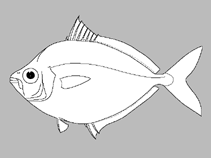
Together, the new species, S. indicius, and S. insidiator are readily distinguished from all congeners except S. hanedai by a more elongate (depth 40.5–57.7% SL) and essentially oval-shaped body (vs. deep and diskshaped in S. ruconius and S. interruptus [depth 53.4–65.5% SL], and S. megalolepis [depth 58.6–62.6% SL]). The new species is distinguished from S. hanedai by the presence of scales on the chest (vs. chest asquamate), and from S. indicius by an overall deeper (depth 47.3–57.7% SL), hatchet-shaped body (vs. body oval, depth 40.5–48.3% SL in S. indicius), and by pigmentation pattern on the dorsal flank comprising eight to eleven well-defined columns of irregular small spots and blotches (vs. 14 to 17 thin columns of spots or vertical lines in S. indicius). The new species is distinguished from S. insidiator by an overall more hatchet-shaped body (vs. body oval and evenly rounded ventrally in S. insidiator), dorsal pigmentation pattern as described above (vs. larger, irregular blotches inpoorly defined columns in S. insidiator), a strongly upturned mouth and compressed pug-like snout, and dorsal-fin insertion well posterior of vertical through pectoral-fin base (vs. about level of pectoral-fin base in S insidiator) (Ref. 87758).
Ciclo vitale e comportamento di accoppiamento
Maturità | Riproduzione | Deposizione | Uova | Fecondità | Larve
Baldwin, Z.H. and J.S. Sparks, 2011. A new species of Secutor (Teleostei: Leiognathidae) from the Western Indian Ocean. Zootaxa 2998:39-47. (Ref. 87758)
Stato della Lista Rossa IUCN (Ref. 130435: Version 2025-2 (Global))
Minaccia per l'uomo
Harmless
Usi umani
Strumenti
Rapporti speciali
Scarica XML
Fonti Internet
Stime basate su modelli
Indice di diversità filogenetica (Fonte Biblio.
82804): PD
50 = 0.5039 [Uniqueness, from 0.5 = low to 2.0 = high].
Bayesian length-weight: a=0.01905 (0.00857 - 0.04236), b=2.95 (2.77 - 3.13), in cm total length, based on LWR estimates for this (Sub)family-body shape (Ref.
93245).
Livello trofico (Fonte Biblio.
69278): 2.7 ±0.3 se; based on size and trophs of closest relatives
Resilienza (Fonte Biblio.
120179): Alto, tempo minimo di raddoppiamento della popolazione meno di 15 mesi (Preliminary K or Fecundity.).
Vulnerabilità della pesca (Ref.
59153): Low vulnerability (10 of 100).
🛈