Classificatie / Namen
Lokale namen | Synoniemen | Catalog of Fishes(Genus, Soort(en)) | ITIS | CoL | WoRMS | Cloffa
>
Siluriformes (Catfishes) >
Amphiliidae (Loach catfishes) > Amphiliinae
Etymology: Amphilius: Greek, amphi = on both sides + Greek, leios = fat.
Eponymy: Dr Paul Krefft (1872–1945) was a German physician and herpetologist at the Stuttgart Museum. He made expeditions to German East Africa, where he collected the catfish holotype. He wrote: Das Terrarium (1908). (Ref. 128868), visit book page.
More on author: Boulenger.
Milieu: milieu / Klimaatzone / Diepte / verspreidingsgebied
Ecologie
; zoet water demersaal. Tropical
Africa: Galana River basin in Kenya (Ref. 85045); Sigi River, Pangani River and Lake Jipe basins in Tanzania (Ref. 85045).
Grootte / Gewicht / Leeftijd
Maturiteit: Lm ? range ? - ? cm
Max length : 20.8 cm SL mannelijk / geslacht onbekend; (Ref. 85045)
Korte beschrijving
Determinatiesleutels | Morfologie | Morfometrie
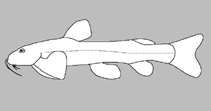
Dorsale stekels (totaal) : 0; Dorsale zachte stralen (totaal) : 6 - 7; Anale stekels: 0; Anale zachte stralen: 8 - 10. Diagnosis: Amphilius krefftii is distinguished from A. chalei, A. grandis, A. athiensis, and A. uranoscopus by its emarginate caudal fin, vs. forked, and from A. grandis and A. athiensis by the presence of distinct pale patches at the origin and insertion of the dorsal fin; it also differs from A. chalei, A. athiensis, A. grandis, and A. uranoscopus by having a short body with usually 36 vertebrae, vs. elongate body with 37-40 vertebrae; it also differs from A. cryptobullatus, A. athiensis, and A. uranoscopus by the absence of dark marking on the body, vs. body mottled in A. cryptobullatus, finely spotted in A. athiensis and with diffuse black stripe along side in A. uranoscopus; it also differs from A. athiensis by the absence of spots on the fins, vs. fins heavily spotted; it also differs from A. chalei by having a deeper body, body depth at anus 11.1-16.5% of standard length vs. 8.9-10.8%, and a deeper caudal peduncle, caudal peduncle depth 10.2-13.5% of standard length vs. 7.1-9.7%; it also differs from A. cryptobullatus by having normally developed bilateral bony swimbladder capsules, vs. bilateral bony swimbladder capsules extremely large (Ref. 85045).
Body shape (shape guide): elongated.
Levenscyclus en paargedrag
Maturiteit | Voortplanting | Paaien | Eieren | Fecunditeit | Larven
Thomson, A.W. and L.M. Page, 2010. Taxonomic revision of the Amphilius uranoscopus group (Teleostei: Siluriformes) in Kenya, with the description of a new species from the Athi River. Bull. Flor. Mus. Nat. Hist. 49(2):45-66. (Ref. 85045)
Status op de Rode Lijst van het IUCN (Ref. 130435: Version 2025-2 (Global))
Gevaar voor de mens
Harmless
Gebruik door de mens
Tools
Speciale rapporten
Download XML
Internetbronnen
Schattingen op basis van modellen
Fylogenetische diversiteitsindex (Ref.
82804): PD
50 = 0.5000 [Uniqueness, from 0.5 = low to 2.0 = high].
Bayesian length-weight: a=0.00490 (0.00203 - 0.01181), b=3.15 (2.94 - 3.36), in cm total length, based on LWR estimates for this (Sub)family-body shape (Ref.
93245).
Trofisch niveau (Ref.
69278): 3.0 ±0.3 se; based on size and trophs of closest relatives
Weerstandsvermogen (Ref.
120179): laag, minimale populatieverdubbelingstijd 4,5-14 jaar (Preliminary K or Fecundity.).
Kwetsbaarheid van de visserij (Ref.
59153): Low vulnerability (15 of 100).
🛈