>
Cyprinodontiformes (Rivulines, killifishes and live bearers) >
Rivulidae (Rivulines) > Cynolebiinae
Etymology: quirogai: Named for Horacio Quiroga, an Uruguayan writer from the early 20th century, whose tales and fables based on his life in the Misiones rainforest inspired the authors to explore nature and its mysteries. Specific epithet is used as a patronym.
Eponymy: Horacio Quiroga (1878–1937) was a Uruguayan writer whose “…tales and fables based on his life in the Misiones rainforest inspired the authors to explore nature and its mysteries. [...] (Ref. 128868), visit book page.
Môi trường: môi trường / vùng khí hậu / Mức độ sâu / phạm vi phân phối
Sinh thái học
; nước ngọt sống nổi và đáy. Subtropical
South America: temporary ponds from the middle to the upper and eastern río Negro tributaries (río Uruguay basin), and río Yaguarón (Laguna Merín basin) in Uruguay.
Bộ gần gũi / Khối lượng (Trọng lượng) / Tuổi
Chín muồi sinh dục: Lm ? range ? - ? cm
Max length : 4.8 cm SL con đực/không giới tính; (Ref. 87318)
Mô tả ngắn gọn
Khóa để định loại | Hình thái học | Sinh trắc học
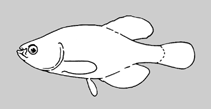
Động vật có xương sống: 28 - 31. Diagnosed from all its congeners by having a unique pigmentation pattern of body and fins in males consisting of a uniform bluish gray background color on the body that lacks vertical bands, and uniform pigmentation of unpaired fins. Can also be distinguished by the combination of characters associated with reduced squamation in the abdominal, preopercular, and opercular regions. The reduction in the number of scales in the abdomen occurs in three alternative states: completely naked abdomen, only a ventral row of small scales, or just area below pectoral fin without scales (vs. scales always absent in anterior part of the abdomen as in Austrolebias gymnoventris); preopercular region is either completely naked or only has a few scales present in its center (vs. preopercular region always naked as in Austrolebias gymnoventris); and the opercular region is from completely naked to only distal edge naked (vs. only opercular distal edge naked as in Austrolebias gymnoventris). However, in extremely large males (SL > 40 mm) and females (SL > 34 mm), which represent less than 7% of individuals analyzed, scales almost completely cover the preopercular, opercular, and abdominal regions (Ref. 87318).
Body shape (shape guide): elongated.
Vòng đời và hành vi giao phối
Chín muồi sinh dục | Sự tái sinh sản | Đẻ trứng | Các trứng | Sự sinh sản | Ấu trùng
Loureiro, M., A. Duarte and M. Zarucki, 2011. A new species of Austrolebias Costa (Cyprinodontiformes: Rivulidae) from northeastern Uruguay, with comments on distribution patterns. Neotrop. Ichthyol. 9(2):335-342. (Ref. 87318)
Tình trạng Sách đỏ IUCN (Ref. 130435: Version 2025-2 (Global))
Mối đe dọa đối với con người
Harmless
Sử dụng của con người
Các nghề cá: không ích lợi (thú vị)
Các công cụ
Báo cáo đặc biệt
Tải xuống XML
Các nguồn internet
Ước tính dựa trên mô hình
Chỉ số đa dạng phát sinh loài (Tài liệu tham khảo
82804): PD
50 = 0.7500 [Uniqueness, from 0.5 = low to 2.0 = high].
Bayesian length-weight: a=0.00617 (0.00266 - 0.01427), b=3.13 (2.93 - 3.33), in cm total length, based on LWR estimates for this (Sub)family-body shape (Ref.
93245).
Mức dinh dưỡng (Tài liệu tham khảo
69278): 3.2 ±0.4 se; based on size and trophs of closest relatives
Thích nghi nhanh (Tài liệu tham khảo
120179): Chiêù cao, thời gian nhân đôi của chủng quần tối thiểu là dưới 15 tháng (Preliminary K or Fecundity.).
Sự dễ bị tổn thương của nghề đánh cá (Ref.
59153): Low vulnerability (10 of 100).
🛈