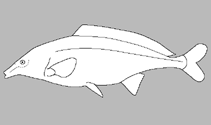
การจำแนกประเภท / ชื่อ
ชื่อสามัญ | ชื่อพ้อง | Catalog of Fishes(สกุล, ชนิด) | ITIS | CoL | WoRMS | Cloffa
>
Osteoglossiformes (Bony tongues) >
Mormyridae (Elephantfishes)
Etymology: Petrocephalus: Latin, petra = stone + Greek, kephale = head (Ref. 45335); similis: The specific epithet similis is given in reference to the resemblance between this new species and P. sullivani (Ref. 87308).
สิ่งแวดล้อม : สิ่งแวดล้อม / เขตภูมิอากาศ / ระดับความลึก / ระยะการกระจายสินค้า
นิเวศวิทยา
; น้ำจืด กลุ่มสัตว์หน้าดิน,กลุ่มสัตว์พื้นท้องน้ำ. Tropical; 7°N - 6°N, 12°E - 13°E
Africa: Djerem River, upper Sanaga basin in Cameroon (Ref. 87308).
ขนาด / น้ำหนัก / อายุ
วัยเจริญพันธุ์: Lm ? range ? - ? cm
Max length : 11.9 cm SL เพศผู้/กระเทย; (Ref. 87308)
คำอธิบายสั้นๆ
เครื่องมือที่ใช้ในการแยกชนิดสัตว์,สิ่งมีชีวิตออกจากกัน | สัณฐานวิทยา | ความยาวต่างๆ
Diagnosis: Petrocephalus similis is distinguished from all other Petrocephalus species of Central Africa by the following combination of characteristics: body coloration gold/silver-white without melanin mark; 22–24 branched rays in the dorsal fin and 28-29 branched rays in the anal fin (Ref. 87308). Petrocephalus similis can be further distinguished from P. simus by its mouth opening under the posterior half of the eye vs. the anterior half of the eye in P. simus); its relatively deep caudal peduncle, the ratio caudal peduncle length and caudal peduncle depth between 2.2 and 2.6 vs. 2.8 in P. simus; and its greater number of scale rows between the anterior base of the anal fin and the lateral line, 16 or 17 vs. 12 in P. simus (Ref. 87308). Petrocephalus similis can be further distinguished from P. sullivani, by its proportionally larger mouth, the ratio head length and mouth width between 3.9 and 4.5 vs. 4.8 in P. sullivani; wider head, the ratio head length and head width between 1.6 and 1.9 vs. 2.0 in P. sullivani; and its shorter caudal peduncle, the ratio standard length and caudal peduncle length between 6.3 and 7.5 vs. 6.3 in P. sullivani (Ref. 87308). From the six Nilo-Sudanian species occurring in the Niger and Chad basins bordering the upper Sanaga, P. similis is easily distinguished from Petrocephalus pallidomaculatus, Petrocephalus soudanensis and Petrocephalus ansorgii by its complete absence of large melanin sub-dorsal spot; from Petrocephalus bane and Petrocephalus sauvagii, by its smaller mouth and fewer branched rays in the dorsal and anal fins; and from Petrocephalus bovei, by its fewer branched rays in the dorsal and anal fins and its larger maximum standard length (Ref. 87308).
Body shape (shape guide): fusiform / normal.
วงจรชีวิตและพฤติกรรมการผสมพันธุ์
วัยเจริญพันธุ์ | การสืบพันธุ์ | การวางไข่ | เซลสืบพันธ์ของเพศเมีย(ไข่) | ความดกของไข่ | ตัวอ่อน
Lavoué, S., 2011. A new species of Petrocephalus Marcusen 1854 (Osteoglossomorpha: Mormyridae) from the Sanaga River basin, Cameroon. Zootaxa 2934:20-28. (Ref. 87308)
สถานะบัญชีแดงของ IUCN (Ref. 130435: Version 2025-2 (Global))
ภัยคุกคามต่อมนุษย์
Harmless
การใช้ของมนุษย์
เครื่องมือ
รายงานพิเศษ
ดาวน์โหลด XML
แหล่งที่มาจากอินเตอร์เน็ต
การประมาณค่าตามแบบจำลอง
ดัชนีความหลากหลายทางวิวัฒนาการ (อ้างอิง
82804): PD
50 = 0.5000 [Uniqueness, from 0.5 = low to 2.0 = high].
Bayesian length-weight: a=0.01549 (0.00672 - 0.03569), b=2.87 (2.69 - 3.05), in cm total length, based on LWR estimates for this Genus-body shape (Ref.
93245).
ระดับชั้นอาหาร (อ้างอิง
69278): 3.3 ±0.4 se; based on size and trophs of closest relatives
ความสามารถในการกลับคืนสู่ปกติ (อ้างอิง
120179): ความสูง, เวลาต่ำสุดที่จะทำให้ประชากรเพิ่มขึ้นเป็น 2 เท่าใช้เวลาน้อยกว่า 15 เดือน (Preliminary K or Fecundity.).
ความเสี่ยงต่อการตกปลา (Ref.
59153): Low vulnerability (10 of 100).
🛈