klasifikasi / Nama
Nama-nama umum | Sinonim (persamaan) | Catalog of Fishes(Marga, Jenis) | ITIS | CoL | WoRMS | Cloffa
>
Siluriformes (Catfishes) >
Loricariidae (Armored catfishes) > Hypostominae
Etymology: Pseudolithoxus: Greek, pseudes = false + Greek, lithos = stone + Greek, oxys = sharp; stearleyi: Named after Ralph Stearley, Professor of Geology at Calvin College since 1992, whose patient introductory tutelage in fish osteology set the first author on his career (Ref. 87303).
Eponymy: Dr Ralph F Stearley is (since 1992) on the faculty of Calvin College, Grand Rapids, Michigan, where he is now Professor of Geology and Palaeontology. [...] (Ref. 128868), visit book page.
Lingkungan: lingkungan / zona iklim / kisaran kedalaman / jangkauan distribusi
Ekologi
; air tawar dasar (demersal). Tropical; 4°N - 3°N, 65°W - 66°W
South America: Venezuela, Amazonas State, Soromoni Creek (Ref. 87303)
Ukuran / Berat / umur
Kematangan: Lm ? range ? - ? cm
Max length : 3.0 cm SL jantan/; (Ref. 87303)
deskripsi pendek
Kunci identifiaksi (pengenalan) | Morfologi | Morfometrik
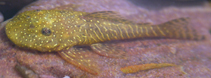
Soromonichthys may be diagnosed from all other Hypostominae by having a unique pattern of plate loss on the snout: Soromonichthys has naked skin covering its anteriormost snout margin, extending posteromedially over the mesethmoid to level approximately coequal with anterior bony rim of nostrils, and posterolaterally to about midlength of snout; plated region restricted to column along either side of mesethmoid that becomes broadly expanded posterolaterally to snout margin. Only three other Hypostominae genera have a loss of snout plates: Ancistrus, Chaetostoma, and Paulasquama. Ancistrus differs from Soromonichthys in having the naked region extending more posteriorly along the lateral margins of the snout and more evenly expanded posteriorly to near midlength of the snout (females) or beyond (males); all Ancistrus have plates along the posterolateralmost margins of the snout as well as medial plates over the posterior mesethmoid. Chaetostoma is similar to Ancistrus but with less developed or absent sexual dimorphism. Paulasquama differs in having naked region confined to bilaterally symmetrical patches on either side of the mesethmoid, each extending posteriorly to the anterior rim of the nostril; plates covering anterior and lateral margins of the snout and extending posteromedially over the mesethmoid continuous with posterior head plates. Soromonichthys is further distinguished from Ancistrus, Chaetostoma, and Paulasquama by having body coloration consisting of thin irregular light yellow to gold bars on a base color of irregularly mixed moderate to dark green (vs. coloration lacking thin light colored bars); from Ancistrus by lacking tentacles emergent from unplated regions of the snout, by having nasal no wider than canal (vs. nasal wide and almost square); and from Chaetostoma by having seven dorsal-fin rays (vs. eight to ten) (Ref. 87303).
Body shape (shape guide): elongated; Cross section: flattened.
All specimens were collected from shallow riffles and runs over clean cobble substrate interspersed with sand and patches of a rooted, moss-like aquatic macrophytes. Other loricariids collected in Soromoni Creek with this species were Ancistrus sp., Dekeyseria niveata, Exastilithoxus sp., and Rineloricaria formosa (Ref. 87303).
Siklus hidup dan perilaku kawin
Kematangan | Reproduksi, perkembang biakan | Pemijahan | telur-telur | Fekunditas | Larva
Lujan, N.K. and J.W. Armbruster, 2011. Two new genera and species of Ancistrini (Siluriformes: Loricariidae) from the Western Guiana Shield. Copeia 2011(2):216-225. (Ref. 87303)
Status IUCN Red List (Ref. 130435: Version 2025-2 (Global))
ancaman kepada manusia
Harmless
penggunaan manusia
Alat, peralatan
laporan khas
muat turun XML
Sumber internet
Estimasi berdasarkan model
Indeks keanekaragaman filogenetik (Acuan
82804): PD
50 = 0.5078 [Uniqueness, from 0.5 = low to 2.0 = high].
Bayesian length-weight: a=0.01549 (0.00726 - 0.03306), b=2.96 (2.79 - 3.13), in cm total length, based on LWR estimates for this (Sub)family-body shape (Ref.
93245).
Kerentanan Penangkapan Ikan (Ref.
59153): Low vulnerability (10 of 100).
🛈