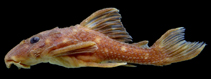
Классификация / Имена
народные названия | синонимы | Catalog of Fishes(род, виды) | ITIS | CoL | WoRMS | Cloffa
>
Siluriformes (Catfishes) >
Loricariidae (Armored catfishes) > Hypostominae
Etymology: Micracanthicus: Name derived from the Greek word mikros meaning small, and acanthicus, the name of the suprageneric clade of which this genus is hypothesized to be a basal member; vandragti: Named for Randy Van Dragt, Professor of Biology at Calvin College since 1981.
Eponymy: Dr Randall ‘Randy’ Van Dragt is a biologist and ecologist who has a bachelor’s degree awarded (1969) by Calvin College, Grand Rapids, Michigan, a master’s from Cornell University (1971) and a doctorate (1985) awarded by the University of Rhode [...] (Ref. 128868), visit book page.
Окружающая среда: среда / климатическая зона / пределы глубины / диапазон распространения
экология
; пресноводный демерсальный. Tropical; 5°N - 4°N, 66°W - 67°W
South America: Venezuela, Amazonas State. Known only from the lower Ventuari River and the Orinoco River near its confluence with the Ventuari (Ref. 87303).
Размер / Вес / Возраст
половая зрелость: Lm ? range ? - ? cm
Max length : 4.2 cm SL самец/пол неопределен; (Ref. 87303)
Краткое описание
определительные ключи | морфология | морфометрия
Micracanthicus vandragti can be distinguished from all other Ancistrini except Hypancistrus and Spectracanthicus by having dentary teeth with longer shafts and larger cusps than premaxillary teeth; from all other Ancistrini except Megalancistrus, Acanthicus, and Panaque (Panaque) by having an enlarged gas bladder and bladder capsule whose posterior margin reaches the expanded rib of the sixth vertebral centrum and whose laterodorsal wall, the compound pterotic, bulges dorsally forming a slight convexity visible externally, with relatively large fenestrae concentrated ventrally; from all other Ancistrini except Hypancistrus, Panaque, Peckoltia, Parancistrus, Exastilithoxus, Lithoxus, Leporacanthicus, Megalancistrus, Pseudacanthicus, and Spectracanthicus by having dentaries with a relatively short tooth cup (mean = 10.9% HL, vs. typically greater than 15% HL); and by having and an intermandibular angle of 90° or less; from Hypancistrus, Panaque, Peckoltia, and Parancistrus by having predorsal plates (excluding nuchal plate) four to five, varying in size and erratically arranged relative to sagittal midline (vs. predorsal plates three to four, similar in size, and bilaterally symmetrical); from Exastilithoxus, Lithoxus, and Leporacanthicus by having a longitudinally oval oral disk (vs. round oral disk); from Leporacanthicus, Megalancistrus, and Pseudacanthicus by having seven dorsal-fin rays (vs. eight to 11); from Exastilithoxus and Leporacanthicus by lacking fimbriate papillae on oral disk margins; from Exastilithoxus and Lithoxus by not being strongly dorsoventrally flattened; from Parancistrus and Spectracanthicus by having dorsal and adipose fins separate (vs. connected by a posterior expansion of the dorsal-fin membrane); from Leporacanthicus by having premaxillary teeth greater than two per ramus and smaller than dentary teeth (vs. premaxillary teeth one or two per ramus and larger than dentary teeth); from Panaque by lacking plates on the abdomen and by having viliform teeth (vs. abdomen plated and teeth thickened and spoon-shaped or elongate and spatulate); and from Hypancistrus by having the snout pointed (vs. rounded) (Ref. 87303).
Body shape (shape guide): elongated; Cross section: flattened.
Most specimens were collected using rotenone at shallow rocky reefs in the main channel of the lower Ventuari River. Water parameters taken at one site were as follows: temperature 32°C; pH 6.9; specific conductivity, 12.9 µS/cm; salinity, 0.0 ppt.; dissolved oxygen, 6.6 mg/l or 90.6% saturation. Thirteen other loricariid species have been collected syntopically with this species: Ancistrus macrophthalmus, Baryancistrus beggini, B. demantoides, Hemiancistrus guahiborum, H. subviridis, Hypancistrus contradens, H. lunaorum, Hypostomus squalinus, Leporacanthicus galaxias, Pseudancistrus orinoco, Pseudolithoxus anthrax, P. tigris, and Spatuloricaria sp. Intestinal contents of 3 specimens examined were mostly amorphous organic detritus and inorganic sediment, although gut contents of one individual included two small snail shells (Ref. 87303).
Жизненный цикл и брачное поведение
половая зрелость | размножение | нерест | икра | Плодовитость | личинки
Lujan, N.K. and J.W. Armbruster, 2011. Two new genera and species of Ancistrini (Siluriformes: Loricariidae) from the Western Guiana Shield. Copeia 2011(2):216-225. (Ref. 87303)
Статус Красного Списка МСОП (Ref. 130435: Version 2025-2 (Global))
Угроза для людей
Harmless
Использование человеком
дополнительная информация
инструменты
Специальные отчеты
Скачать в формате XML
ресурсы в Интернет
Оценки, основанные на моделях
Индекс филогенетического разнообразия (ссылка
82804): PD
50 = 1.0000 [Uniqueness, from 0.5 = low to 2.0 = high].
Bayesian length-weight: a=0.01549 (0.00726 - 0.03306), b=2.96 (2.79 - 3.13), in cm total length, based on LWR estimates for this (Sub)family-body shape (Ref.
93245).
Уязвимость рыбной ловли (Ref.
59153): Low vulnerability (10 of 100).
🛈