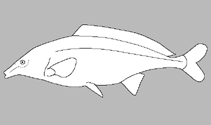
>
Osteoglossiformes (Bony tongues) >
Mormyridae (Elephantfishes)
Etymology: Petrocephalus: Latin, petra = stone + Greek, kephale = head (Ref. 45335); pulsivertens: The species name comes from the Latin 'pulsus', meaning impulse, beating; and from 'vertere', meaning to turn, exchange; the name describes the unusual EOD waveform of the species (Ref. 85331).
Entorno: milieu / zona climática / rango de profundidad / gama de distribución
Ecología
; agua dulce bentopelágico. Tropical
Africa: middle Congo River basin (Ref. 85331, 113655) in Cameroon, Central African Republic and Republic of Congo.
Tamaño / Peso / Edad
Madurez: Lm ? range ? - ? cm
Max length : 11.5 cm SL macho / no sexado; (Ref. 85331)
Diagnosis: Petrocephalus pulsivertens is distinguished from all other Petrocephalus species in Central Africa by the following combination of characteristics: dorsal fin with at least 25 branched rays; anal fin with at least 31 branched rays; mouth large, the ratio head length and mouth width between 2.0 and 3.7; 15-21 teeth in the upper jaw; 24-30 teeth in the lower jaw; and eye large, the ratio head length and eye-diameter between 3,2 and 3,5 (Ref. 85331). Pigmentation pattern consists of two distinctive melanin markings (black patches): (1) a distinct ovoid mark below the anterior base of the dorsal fin; and (2) a crescent-like mark, sometimes diffuse, centered at the base of the caudal fin and extending onto the upper and lower parts of the caudal fin (Ref. 85331).
Body shape (shape guide): fusiform / normal.
The EOD waveform of Petrocephalus pulsivertens resembles an inverted-polarity version of the 'typical' Petrocephalus EOD (Ref. 85331).
Ciclo vital y comportamiento de apareamiento
Madurez | Reproducción | Puesta | Huevos | Fecundidad | Larva
Lavoué, S., J.P. Sullivan and M.E. Arnegard, 2010. African weakly electric fishes of the genus Petrocephalus (Osteoglossomorpha: Mormyridae) of Odzala National Park, Republic of the Congo (Lékoli River, Congo River basin) with description of five new species. Zootaxa 2600:1-52. (Ref. 85331)
Situación en la Lista Roja de la UICN (Ref. 130435: Version 2025-2 (Global))
Amenaza para el ser humano
Harmless
Usos humanos
Herramientas
Informes especiales
Descargar XML
Fuentes de Internet
Estimaciones basadas en modelos
Índice de diversidad filogenética (Referencia
82804): PD
50 = 0.5000 [Uniqueness, from 0.5 = low to 2.0 = high].
Bayesian length-weight: a=0.01549 (0.00672 - 0.03569), b=2.87 (2.69 - 3.05), in cm total length, based on LWR estimates for this Genus-body shape (Ref.
93245).
Nivel trófico (Referencia
69278): 3.2 ±0.4 se; based on size and trophs of closest relatives
Resiliencia (Referencia
120179): Alto, población duplicada en un tiempo mínimo inferior a 15 meses (Preliminary K or Fecundity.).
Vulnerabilidad pesquera (Ref.
59153): Low vulnerability (10 of 100).
🛈