>
Lophiiformes (Anglerfishes) >
Histiophrynidae (Starfingered frogfishes)
Etymology: Histiophryne: Greek, istion, istos = sail + Greek, phryne = toad (Ref. 45335); maggiewalker: Named for Maggie Walker for her service and dedication to science and education at the University of Washington and The Burke Museum of Natural History and Culture (Ref. 87287).
Eponymy: Margaret ‘Maggie’ Walker (d: 1953) was a graduate of, and benefactor to, the University of Washington and The Burke Museum of Natural History and Culture. [...] (Ref. 128868), visit book page.
Miljö: miljö / Klimatzon / djupintervall / distributionsområde
Ekologi
marina bottenlevande; djupintervall 7 - 12 m (Ref. 87287). Tropical
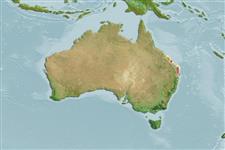
Pacifique: Australia.
Storlek / Vikt / Ålder
Könsmognad: Lm ? range ? - ? cm
Max length : 5.5 cm SL hane/ej könsbestämd; (Ref. 87287); 6.0 cm SL (female)
Kort beskrivning
Bestämningsnycklar | Morfologi | Morfometri
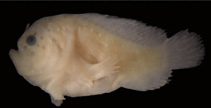
Mjukstrålar i ryggfenan (totalt) : 15; Mjukstrålar i analfenan: 8; Ryggkotor: 21 - 22. A frogfish of the lophiiform family Antennariidae, genus Histiophryne, unique in having a relatively long illicium and esca, the latter expanded distally, its shape more or less rectangular with rounded edges, and genetic divergence in the nuclear recombination activation gene-2 (RAG2) and cytochrome oxidase-I (COI) genes (Ref. 87287).
Body short and deep, somewhat compressed laterally, vertebral column distinctly sigmoid in shape; head large, its length approximately 29−39% standard length (SL); mouth small(relative to other antennariid taxa), opening strongly oblique to nearly vertical. Jaws bearing 2–4 irregular rows of small villiform teeth; similar teeth present on vomer and palatine. Eye diameter 4.5–4.9% and 8.8–9.1% SL for adults (four specimens) and juveniles (two specimens), respectively. Spinous dorsal fin consisting of three widely spaced spines, anteriormost spine (illicium) relatively long (2.5–4.7% SL); second and third dorsal-fin spines laid back and bound down to surface of head by thick skin; esca relatively long (4.1–6.4% SL), more or less rectangular with rounded edges. Pectoral-fin lobe elongate, leg-like, attached to side of body by loose skin for most of its length. Opercular opening restricted to a small, elongate, tube-like opening situated immediately posteroventral to base of pectoral fin. Caudal peduncle absent, thick fleshy posteriormost margin of soft-dorsal and anal fins extending posteriorly well beyond base of caudal fin, connecting to outermost caudal-fin rays. Skin covering head and body everywhere thick, fleshy, and naked, lacking any visible trace of dermal spinules or cutaneous filaments or appendages. Rays of dorsal, anal, pectoral, and pelvic fins all simple; those of caudal fin all bifurcate. Dorsal-fin rays 15; anal-fin rays 8; pectoral-fin rays 8; pelvic fin with 1 spine and 5 rays; caudal-fin rays 9; vertebrae 21–22, including the anteriormost and posteriormost centra fused to the cranium and hypural plate, respectively (Ref. 87287).
Body shape (shape guide): short and / or deep; Cross section: compressed.
Known only from shallow inshore waters. While some frogfishes are notorious for their insatiable appetite, including tendencies to cannibalize one another, it is possible these four were living together peacefully (Ref. 87287).
Livscykel och parningsbeteende
Könsmognad | Reproduktion | Lek | Ägg | Fekunditet | Larver
Arnold, R.J. and T.W. Pietsch, 2011. A new species of frogfish of the genus Histiophryne (Teleostei: Lophiiformes: Antennariidae) from Queensland, Australia. Zootaxa 2925:63-68 (Ref. 87287)
Status på IUCN:s rödlista (Ref. 130435: Version 2025-2 (Global))
Hot mot människor
Harmless
Mänskliga användningsområden
Verktyg
Särskilda rapporter
Ladda ner XML
Internet-källor
Uppskattningar baserade på modeller
Önskad temperatur (Ref.
123201): 23.6 - 24.3, mean 24 °C (based on 19 cells).
Index för fylogenetisk mångfald (Ref.
82804): PD
50 = 0.5313 [Uniqueness, from 0.5 = low to 2.0 = high].
Bayesian length-weight: a=0.01995 (0.00906 - 0.04395), b=3.01 (2.83 - 3.19), in cm total length, based on all LWR estimates for this body shape (Ref.
93245).
Trofisk nivå (Ref.
69278): 3.5 ±0.5 se; based on size and trophs of closest relatives
Resiliens (Ref.
120179): Hög, lägsta populationsfördubblingstid mindre än 15 månader (Fec assumed to be > 10,000).
Sårbarhet i fisket (Ref.
59153): Low vulnerability (10 of 100).
🛈