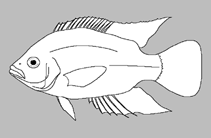
>
Cichliformes (Cichlids, convict blennies) >
Cichlidae (Cichlids) > Pseudocrenilabrinae
Etymology: Petrotilapia: Latin,petra = stone + Bechuana, African native thiape = fish (Ref. 45335); pyroscelos: The name pyroscelos is from the Greek pyros, meaning fire, and skelos, meaning leg, referring to the pelvic fins of males that have the color of fire; a noun in apposition (Ref. 87181).
Môi trường: môi trường / vùng khí hậu / Mức độ sâu / phạm vi phân phối
Sinh thái học
; nước ngọt tầng nổi. Tropical; 12°S - 13°S, 34°E - 35°E
Africa: Lake Malawi in Malawi (Ref. 87181).
Bộ gần gũi / Khối lượng (Trọng lượng) / Tuổi
Chín muồi sinh dục: Lm ? range ? - ? cm
Max length : 10.7 cm SL con đực/không giới tính; (Ref. 87181)
Mô tả ngắn gọn
Khóa để định loại | Hình thái học | Sinh trắc học
Các tia vây lưng cứng (tổng cộng) : 17 - 19; Các vây lưng mềm (tổng cộng) : 8 - 10; Tia cứng vây hậu môn: 3; Tia mềm vây hậu môn: 7 - 8. Diagnosis: The dark submarginal band in the spinous part of the dorsal fin of both male and female distinguishes Petrotilapia pyroscelos from P. tridentiger, P. xanthos, P. flaviventris, and P. palingnathos, which lack such a band (Ref. 87181). Males of P. pyroscelos have blue and bronze ground color with 7-9 gray vertical bars, whitish to gray throat and purple cheek, which distinguishes it from P. genalutea, P. nigra, P. chrysos, P. microgalana and P. mumboensis; males of P. genalutea are dull gray-blue with 5-7 black vertical bars, have an orange-yellow cheek, and a black throat; males of P. nigra and P. chrysos are predominantly blue-black with 7-10 gray/brown bars, have a dark blue cheek, and a black throat; males of P. microgalana are bright blue with 5-7 faint black vertical bars, and have a light blue cheek and a yellow throat, while those of P. mumboensis are blue with 8 dark blue vertical bars, light blue cheeks, and a light blue to gray gular region (Ref. 87181). Females of P. pyroscelos are brown with faint blue and yellow highlights with a conspicuous black submarginal band in the dorsal fin; females of P. pyroscelos are distinguished from those of P. genalutea, P. nigra, P. chrysos, and P. microgalana by the brown to gray ground color on the flank which is beige or yellow in the other species and are distinguished from females of P. mumboensis which lack any horizontal elements of the flank’s pigmentation pattern (Ref. 87181).
Body shape (shape guide): fusiform / normal.
Vòng đời và hành vi giao phối
Chín muồi sinh dục | Sự tái sinh sản | Đẻ trứng | Các trứng | Sự sinh sản | Ấu trùng
Lundeba, M., J.R. Stauffer Jr. and A. F. Konings, 2011. Five new species of the genus Petrotilapia (Teleostei: Cichlidae), from Lake Malawi, Africa. Ichthyol. Explor. Freshwat. 22(2):149-168. (Ref. 87181)
Tình trạng Sách đỏ IUCN (Ref. 130435: Version 2025-2 (Global))
Mối đe dọa đối với con người
Harmless
Sử dụng của con người
Các công cụ
Báo cáo đặc biệt
Tải xuống XML
Các nguồn internet
Ước tính dựa trên mô hình
Chỉ số đa dạng phát sinh loài (Tài liệu tham khảo
82804): PD
50 = 0.5010 [Uniqueness, from 0.5 = low to 2.0 = high].
Bayesian length-weight: a=0.01445 (0.00671 - 0.03113), b=2.99 (2.82 - 3.16), in cm total length, based on LWR estimates for this (Sub)family-body shape (Ref.
93245).
Mức dinh dưỡng (Tài liệu tham khảo
69278): 3.3 ±0.4 se; based on size and trophs of closest relatives
Thích nghi nhanh (Tài liệu tham khảo
120179): Chiêù cao, thời gian nhân đôi của chủng quần tối thiểu là dưới 15 tháng (Preliminary K or Fecundity.).
Sự dễ bị tổn thương của nghề đánh cá (Ref.
59153): Low vulnerability (10 of 100).
🛈