klasifikasi / Nama
Nama-nama umum | Sinonim (persamaan) | Catalog of Fishes(Marga, Jenis) | ITIS | CoL | WoRMS | Cloffa
>
Cichliformes (Cichlids, convict blennies) >
Cichlidae (Cichlids) > Pseudocrenilabrinae
Etymology: Petrotilapia: Latin,petra = stone + Bechuana, African native thiape = fish (Ref. 45335); xanthos: The name xanthos, from the Greek, meaning yellow referring to the yellow breeding color of males; a noun in apposition (Ref. 87181).
Lingkungan: lingkungan / zona iklim / kisaran kedalaman / jangkauan distribusi
Ekologi
; air tawar pelagis, permukaan. Tropical; 10°S - 11°S, 34°E - 35°E
Africa: Gallireya Reef in Lake Malawi, Malawi (Ref. 87181).
Ukuran / Berat / umur
Kematangan: Lm ? range ? - ? cm
Max length : 13.0 cm SL jantan/; (Ref. 87181)
deskripsi pendek
Kunci identifiaksi (pengenalan) | Morfologi | Morfometrik
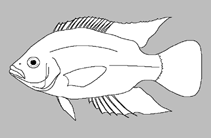
Duri punggung (Keseluruhan (total)) : 17 - 19; duri punggung lunak (Keseluruhan (total)) : 6 - 10; Duri dubur: 3; Sirip dubur lunak: 7 - 9. Diagnosis: The absence of a dark submarginal band in the dorsal fin distinguishes Petrotilapia xanthos from P. microgalana, P. genalutea, P. nigra, P. chrysos, P. mumboensis, and P. pyroscelos which have such a band (Ref. 87181). Adult males of P. xanthos are yellow, which distinguishes them from P. tridentiger, which are light blue with dark blue bars; they are also distinct from those of P. flaviventris, and P. palingnathos; males of P. flaviventris are yellow on ventral and mid flank with scales outlined in blue; the dorsal one-third is blue to gray with yellow and orange highlights; cheeks and throat yellow to orange; adult male, and female, P. palingnathos have distinctly retrognathous jaws and can thus be distinguished from those of P. xanthos (Ref. 87181). Females of P. xanthos are light brown, which distinguishes them from those of P. tridentiger, which are brown, from P. chrysos and P. microgalana, which are golden yellow, from those of P. flaviventris, which are yellow brown with interrupted black stripes and fading to dark brown dorsally; the melanin pattern in females of P. xanthos have both horizontal and vertical elements, which distinguishes them from those of P. chrysos, which lack a distinct melanin pattern and are completely yellow, and from P. microgalana and P. flaviventris, which have no vertical elements in their melanin pattern (Ref. 87181).
Body shape (shape guide): short and / or deep.
Siklus hidup dan perilaku kawin
Kematangan | Reproduksi, perkembang biakan | Pemijahan | telur-telur | Fekunditas | Larva
Lundeba, M., J.R. Stauffer Jr. and A. F. Konings, 2011. Five new species of the genus Petrotilapia (Teleostei: Cichlidae), from Lake Malawi, Africa. Ichthyol. Explor. Freshwat. 22(2):149-168. (Ref. 87181)
Status IUCN Red List (Ref. 130435: Version 2025-2 (Global))
ancaman kepada manusia
Harmless
penggunaan manusia
Alat, peralatan
laporan khas
muat turun XML
Sumber internet
Estimasi berdasarkan model
Indeks keanekaragaman filogenetik (Acuan
82804): PD
50 = 0.5010 [Uniqueness, from 0.5 = low to 2.0 = high].
Bayesian length-weight: a=0.00389 (0.00180 - 0.00842), b=3.12 (2.94 - 3.30), in cm total length, based on all LWR estimates for this body shape (Ref.
93245).
Tingkat Trofik (Acuan
69278): 3.4 ±0.4 se; based on size and trophs of closest relatives
Daya lenting (Acuan
120179): Tinggi, Waktu penggandaan populasi minimum kurang dari 15 bulan (Preliminary K or Fecundity.).
Kerentanan Penangkapan Ikan (Ref.
59153): Low vulnerability (10 of 100).
🛈