Clasificación / Nombres
Nombres comunes | Sinónimos | Catalog of Fishes(Género, Especie) | ITIS | CoL | WoRMS | Cloffa
>
Cyprinodontiformes (Rivulines, killifishes and live bearers) >
Nothobranchiidae (African rivulines)
Etymology: Nothobranchius: Greek, nothos = false + Greek, brangchia = gill (Ref. 45335); seegersi: The species is named in dedication to its first collector, the enthusiastic aquarist and ichthyologist Lothar Seegers, Germany (Ref. 87047).
Eponymy: Dr Lothar Seegers (1947–2018) was a German biologist and enthusiastic aquarist. [...] (Ref. 128868), visit book page.
Entorno: milieu / zona climática / rango de profundidad / gama de distribución
Ecología
; agua dulce bentopelágico. Tropical
Africa: seasonal pools in the drainage system of Wulua and Mungu Rivers, Malagarasi River basin, in Tanzania (Ref. 87047, 98818).
Tamaño / Peso / Edad
Madurez: Lm ? range ? - ? cm
Max length : 6.2 cm SL macho / no sexado; (Ref. 87047); 5.5 cm SL (female)
Descripción breve
Claves de identificación | Morfología | Morfometría
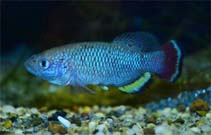
Espinas dorsales (total) : 0; Radios blandos dorsales (total) : 16 - 17; Espinas anales: 0; Radios blandos anales: 17 - 18; Vértebra: 31 - 32. Diagnosis: Males of Nothobranchius seegersi share with the other members of the Nothobranchius neumanni species group a combination of colouration characters, which distinguish them from all other species of the genus: caudal fin red or partially red; pectoral fin hyaline; anal fin yellow with red stripes, proximal portion light bluish grey (Ref. 87047). It is distinguihed from N. neumanni by bright light blue scales, vs. pale bluish grey; an irregular pattern formed by red scale margins on lateral body and head vs. uniform; and a single, blue male colour morph, vs. two colour morphs, blue and red; both male and female of N. seegersi have a relatively higher predorsal length compared to N. neumanni, 60.3-68.8 vs. 54.8-61.0% of standard length in males, 68.0-68.4 vs. 57.1-64.6% of standard length in females (Ref. 87047). Based on osteological characters, Nothobranchius seegersi differs from N. neumanni by having a conspicuously longer lateral process of the post-temporal, and by having short antero-dorsal process of the urohyal (Ref. 87047).
Body shape (shape guide): fusiform / normal.
This species is found in seasonal pools; the type locality was at the time of collection a small and very shallow pond, about 3x5 m wide and 0.25 m deep, without aquatic vegetation, in the open woodland; the water was brown and very turbid (Ref. 87047).
Ciclo vital y comportamiento de apareamiento
Madurez | Reproducción | Puesta | Huevos | Fecundidad | Larva
Valdesalici, S. and K. Kardashev, 2011. Nothobranchius seegersi (Cyprinodontiformes: Nothobranchiidae), a new annual killifish from the Malagarasi River drainage, Tanzania. Bonn Zool. Bull. 60(1):89-93. (Ref. 87047)
Situación en la Lista Roja de la UICN (Ref. 130435: Version 2025-2 (Global))
Amenaza para el ser humano
Harmless
Usos humanos
Pesquerías: sin interés
Herramientas
Informes especiales
Descargar XML
Fuentes de Internet
Estimaciones basadas en modelos
Índice de diversidad filogenética (Referencia
82804): PD
50 = 0.5000 [Uniqueness, from 0.5 = low to 2.0 = high].
Bayesian length-weight: a=0.01096 (0.00461 - 0.02608), b=2.94 (2.74 - 3.14), in cm total length, based on LWR estimates for this (Sub)family-body shape (Ref.
93245).
Nivel trófico (Referencia
69278): 3.3 ±0.4 se; based on size and trophs of closest relatives
Vulnerabilidad pesquera (Ref.
59153): Low vulnerability (10 of 100).
🛈