Classificazione / Nomi
Nomi Comuni | Sinonimi | Catalog of Fishes(Genere, Specie) | ITIS | CoL | WoRMS | Cloffa
>
Perciformes/Serranoidei (Groupers) >
Anthiadidae (Fairy basslets or Streamer basses)
Etymology: Pyronotanthias: Name from Greek πυρ, fire, νοτος, back, and Anthias. It ; referring to the characteristic red blotches or
stripes on the upper caudal peduncle and beneath the posterior part of the dorsal fin of the included species.
is masculine; unimarginatus: Named for its colourful broad margin dorsally on the caudal fin that is not duplicated on the ventral margin.
More on author: Randall.
Ambiente: milieu / zona climatica / distribuzione batimetrica / gamma di distribuzione
Ecologia
marino associati a barriera corallina. Tropical
Western Indian Ocean: Mauritius.
Dimensione / Peso / Età
Maturità: Lm ? range ? - ? cm
Max length : 5.3 cm SL maschio/sesso non determinato; (Ref. 86964)
Breve descrizione
Chiavi di identificazione | Morfologia | Morfometria
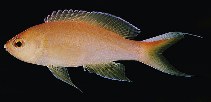
Spine dorsali (totale) : 10; Raggi dorsali molli (totale) : 16; Spine anali: 3; Raggi anali molli: 7; Vertebre: 26. This species is distinguished by the following characters: D X,16; A III,7; pectoral-fin rays 18; lateral-line scales 43; gill rakers 9 + 25; body depth 3.05 in SL; head length 3.1 in SL; anterior end of upper lip thickened; papillae ventroposteriorly on edge of orbit; no serrae on edge of subopercle nor on interopercle; snout length 3.9 in HL; bony interorbital width 4.0 in HL; 4th-10th dorsal spines subequal, 2.8 in HL; caudal fin lunate, 2.3 in SL; body color orange-yellow, shading to pale lavender-yellow ventrally, head yellow, paler ventrally, a large elliptical orange area, bordered by magenta, dorsally on head from snout to nape, anterior end of upper lip pale lavender-pink, caudal fin yellow with a broad pale blue upper margin and red submarginal band that narrows posteriorly, remaining fins translucent yellow, the dorsal fin with a pink margin, and the anal and pelvic fins with a narrow blue margin (Ref. 86964).
Body shape (shape guide): fusiform / normal.
Only specimen collected with anaesthetic from a patch reef at 53 m where Chaetodon mitratus and Pseudanthias pulcherrimus are often collected. It quickly takes refuge in a crack in the reef when threatened (Ref. 86964).
Ciclo vitale e comportamento di accoppiamento
Maturità | Riproduzione | Deposizione | Uova | Fecondità | Larve
Gill, A.C., 2022. Revised definitions of the anthiadine fish genera Mirolabrichthys Herre and Nemanthias Smith, with description of a new genus (Teleostei: Serranidae). Zootaxa 5092(1):041-066. (Ref. 127988)
Stato della Lista Rossa IUCN (Ref. 130435: Version 2025-2 (Global))
Minaccia per l'uomo
Harmless
Usi umani
Strumenti
Rapporti speciali
Scarica XML
Fonti Internet
Stime basate su modelli
Indice di diversità filogenetica (Fonte Biblio.
82804): PD
50 = 0.5020 [Uniqueness, from 0.5 = low to 2.0 = high].
Bayesian length-weight: a=0.01413 (0.00621 - 0.03212), b=3.00 (2.81 - 3.19), in cm total length, based on LWR estimates for this (Sub)family-body shape (Ref.
93245).
Livello trofico (Fonte Biblio.
69278): 3.3 ±0.4 se; based on size and trophs of closest relatives
Vulnerabilità della pesca (Ref.
59153): Low vulnerability (10 of 100).
🛈