Classificazione / Nomi
Nomi Comuni | Sinonimi | Catalog of Fishes(Genere, Specie) | ITIS | CoL | WoRMS | Cloffa
>
Siluriformes (Catfishes) >
Amphiliidae (Loach catfishes) > Leptoglaninae
Etymology: Zaireichthys: Composed form Zaire river + Greek,ichtys = fish; the habitat of this fish (Ref. 45335); lacustris: The specific name, 'lacustris', refers to the first species of the genus to be known from a lacustrine environment (Ref. 86935).
Ambiente: milieu / zona climatica / distribuzione batimetrica / gamma di distribuzione
Ecologia
; acqua dolce benthopelagico; distribuzione batimetrica 10 - 30 m (Ref. 86935). Tropical
Africa: endemic to Lake Malawi (Ref. 86935).
Lunghezza alla prima maturità / Dimensione / Peso / Età
Maturità: Lm 1.7 range ? - ? cm
Max length : 2.2 cm SL maschio/sesso non determinato; (Ref. 86935); 2.0 cm SL (female)
Breve descrizione
Chiavi di identificazione | Morfologia | Morfometria
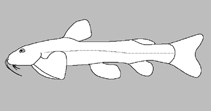
Spine dorsali (totale) : 2; Raggi dorsali molli (totale) : 4 - 5; Spine anali: 0; Raggi anali molli: 9 - 11. Diagnosis: This species is distinguished from all other members of the genus by the short snout, which is less than one third of the head length, and by its unique habitat, occupying empty snail shells in the lake (Ref. 86935).
Body shape (shape guide): elongated.
This species is recorded from depths of 10-30 m in the southern part and at a depth of about 20 m at Sanga in the central portion of Lake Malawi (Ref. 86935). It has been taken by trawl over the sandy substrata near Monkey Bay, where it is found in empty gastropod shells, and it is also collected in shells by divers (Ref. 86935). It is inquiline with the cichlid fish Pseudotropheus lanisticola in shells of the large gastropod Lanistes nyassanus; the co-existence of the two species in one shell is fortuitous and the catfish occupies probably the upper part of the shell which the cichlid cannot reach (Ref. 86935). Both sexes attain maturity at a standard length of about 17 mm (Ref. 86935). Mature males take up territories in shells; females may share these for some time before depositing their eggs; it appears that females leave the shells shortly after oviposition whereas the males remain in the shells, presumably to guard the brood; the small size of the buccal cavity and the narrow mouth with a width less than 2.5 egg diameters, suggests that mouth brooding is improbable (Ref. 86935). It feeds on ostracods, cladocerans, copepods, chironomid larvae and small trichopteran larvae; some diatom frustules were also observed but it is possible that these were taken fortuitously with invertebrate food items (Ref. 86935).
Ciclo vitale e comportamento di accoppiamento
Maturità | Riproduzione | Deposizione | Uova | Fecondità | Larve
Mature males take up territories in shells; females may share these for some time before depositing their eggs; it appears that females leave the shells shortly after oviposition whereas the males remain in the shells, presumably to guard the brood; the small size of the buccal cavity and the narrow mouth with a width less than 2.5 egg diameters, suggests that mouth brooding is improbable (Ref. 86935).
Eccles, D.H., D. Tweddle and P.H. Skelton, 2011. Eight new species in the dwarf catfish genus Zaireichthys (Siluriformes: Amphiliidae). Smithiana Bull. (13):3-28. (Ref. 86935)
Stato della Lista Rossa IUCN (Ref. 130435: Version 2025-2 (Global))
Minaccia per l'uomo
Harmless
Usi umani
Strumenti
Rapporti speciali
Scarica XML
Fonti Internet
Stime basate su modelli
Indice di diversità filogenetica (Fonte Biblio.
82804): PD
50 = 0.5000 [Uniqueness, from 0.5 = low to 2.0 = high].
Bayesian length-weight: a=0.00389 (0.00180 - 0.00842), b=3.12 (2.94 - 3.30), in cm total length, based on all LWR estimates for this body shape (Ref.
93245).
Livello trofico (Fonte Biblio.
69278): 3.0 ±0.4 se; based on size and trophs of closest relatives
Vulnerabilità della pesca (Ref.
59153): Low vulnerability (10 of 100).
🛈