Classificação / Nomes
Nomes comuns | Sinônimos | Catalog of Fishes(Gênero, Espécies) | ITIS | CoL | WoRMS | Cloffa
>
Cyprinodontiformes (Rivulines, killifishes and live bearers) >
Nothobranchiidae (African rivulines)
Etymology: Aphyosemion: Greek, aphye, -es, sardine, anchovy + Greek, semeion = mark, signal (Ref. 45335); musafirii: Named after Dr. Jean Musafiri (Ubundu, Democratic Republic of Congo), coordinator for the national tuberculosis and leprosy control programme in the 'Province Orientale Occidentale', the huge forest area around Kisangani; the name Musafiri means 'traveler' in Swahili; indeed, he travels around the area under very difficult circumstances, covering enormous distances by jeep, motorised canoe or small motorcycle; Dr. Musafiri was born in Ubundu and has always stayed in the province to help his people, in spite of the very difficult living conditions and the atrocities of the war in the eastern Democratic Republic of Congo; he made it possible that the type material of Aphyosemion musafirii and a new species of Fenerbahce could be collected by A. Van Deun, Institute of Tropical Medicine, Antwerp, at the occasion of an external evaluation visit of the tuberculosis/leprosy programme (Ref. 86918).
Eponymy: Dr Jean Musafiri is coordinator for the national tuberculosis and leprosy control programme in the ‘Province Orientale Occidentale’, a large forested area around Kisangani (DRC). [...] (Ref. 128868), visit book page.
Meio ambiente: milieu / Zona climática / intervalo de profundidade / faixa de distribuição
Ecologia
; Água doce pelágico(a,os,as). Tropical
Africa: brooks in Ruiki and Romée River systems on the left bank of Congo River between Kisangani and Ubundu (Ref. 86918).
Tamanho / Peso / Idade
Maturidade: Lm ? range ? - ? cm
Max length : 3.7 cm SL macho/indeterminado; (Ref. 86918)
Descrição suscinta
Chaves de identificação | Morfologia | Morfometria
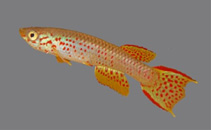
Espinhos dorsais (total) : 0; Raios dorsais (total) : 7 - 9; Espinhos anais: 0; Raios anais : 13 - 15. Diagnosis: Aphyosemion musafirii is placed within the genus Aphyosemion by the combination of the following characters: preopercular neuromast system with 6 pores, slender body, posterior origin of dorsal fin with less than 10 fin rays, females with a strong reticulation due to dark scale borders, and the extended edges of the caudal fin in males (Ref. 86918). Males of A. musafirii differ from all other representatives of Aphyosemion in the north-eastern Congo basin by the in average broader red margin of the dorsal fin; this red border is narrow, up to 10%, in all other species in this area and is often absent at the distal end of the fin (Ref. 86918). Males of A. musafirii differ from A. castaneum by the absence of a red band in the approximate centre of the anal fin, absence of a red infra-buccal band, absence of red edges around the light ventral zone in the caudal fin, absence of, or only very narrow, yellow margin of pelvic fins and a higher average number of red dots on side, between 51-79 in A. musafirii vs. 13-57 in A. castaneum; these dots are arranged in more or less regular, interrupted rows in A. musafirii, whereas these dots are irregularly distributed in A. castaneum (Ref. 86918). The higher number of red dots on the side also distinguishes males of A. congicum (25-40), A. schoutedeni (17-28) and A. polli (11-49) from A. musafirii; it can also be distinguished by the more or less regular interrupted rows of red dots from A. sp. Cuvette, A. elegans and A. plagitaenium, which have either a pattern of vertical streaks or oblique bars on the side of males; males of A. musafirii differ from A. schoutedeni by the same characters as A. castaneum, with the exception that A. schoutedeni lacks a red band in the anal fin; males of A. musafirii have less spots in the caudal fin than A. christyi, 35-55 vs. more than 70; the background colour of the flanks is blue-green in A. musafirii and purple-blue in A. christyi; in addition to colouration characters, males of A. musafirii can be distinguished from A. christyi by the lower number of dorsal fin rays, 7-9 vs. 10-11 (Ref. 86918).
Body shape (shape guide): fusiform / normal.
Ciclo de vida ou comportamento de acasalamento
Maturidade | Reprodução | Desova | Ovos | Fecundidade | Larvas
Van der Zee, J.R. and R. Sonnenberg, 2011. Aphyosemion musafirii (Cyprinodontiformes: Nothobranchiidae), a new species from the Tshopo Province in the Democratic Republic of Congo, with some notes on the Aphyosemion of the Congo Basin. Bonn Zool. Bull. 60(1):73-87. (Ref. 86918)
Status na Lista Vermelha da UICN (Ref. 130435: Version 2025-2 (Global))
Ameaça para os humanos
Harmless
Uso pelos humanos
Ferramentas
Relatórios especiais
Baixar XML
Fontes da internet
Estimativas baseadas em modelos
Índice de diversidade filogenética (Ref.
82804): PD
50 = 0.5000 [Uniqueness, from 0.5 = low to 2.0 = high].
Bayesian length-weight: a=0.00603 (0.00250 - 0.01453), b=3.13 (2.93 - 3.33), in cm total length, based on LWR estimates for this (Sub)family-body shape (Ref.
93245).
Nível Trófico (Ref.
69278): 3.2 ±0.4 se; based on size and trophs of closest relatives
Vulnerabilidade da pesca (Ref.
59153): Low vulnerability (10 of 100).
🛈