Classificazione / Nomi
Nomi Comuni | Sinonimi | Catalog of Fishes(Genere, Specie) | ITIS | CoL | WoRMS | Cloffa
Elasmobranchi (squali e razze) (sharks and rays) >
Myliobatiformes (Stingrays) >
Potamotrygonidae (River stingrays) > Potamotrygoninae
Etymology: Plesiotrygon: Greek, plesios = near + Greek, trygon = a sting ray (Ref. 45335); nana: The specific epithet nana is in reference to its dwarf size (from the Latin nanus). Gender feminine (Ref. 86912).
Ambiente: milieu / zona climatica / distribuzione batimetrica / gamma di distribuzione
Ecologia
; acqua dolce demersale. Tropical; 9°S - 10°S
South America: Peru. Río Pachitea, tributary of Río Ucayali, up-river from town of Puerto Inca, Puerto Inca Province, Huánuco Department (Ref. 86912).
Dimensione / Peso / Età
Maturità: Lm ? range ? - ? cm
Max length : 24.7 cm WD maschio/sesso non determinato; (Ref. 86912)
Breve descrizione
Chiavi di identificazione | Morfologia | Morfometria
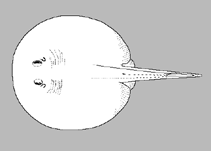
A species of Plesiotrygon diagnosed by the following unique characters: (1) dorsal color pattern composed of a dark gray to dark brown background color, with tan to yellow highly curved, slender and convoluted stripes or small spots forming rosette-like pattern over dorsal disc, or with creamy white to yellowish irregularly shaped, scattered spots and ocelli, smaller than interorbital distance (pale gray or brown dorsal background color in P. iwamae, composed of faint, incomplete markings outlined by small spots, or small irregular blotches and creamy, faint spots); (2) disc circular in preadults and adults, about as wide as long (markedly oval in P. iwamae in all sizes); (3) broadly rounded anterior disc (anterior disc sharply oval in P. iwamae); (4) spiracles only faintly rhomboidal, very small, ranging from 2.8 to 3.5% DW in adult and preadult specimens (spiracle strongly rhomboidal, with mean spiracle length 6.8% DW in P. iwamae); (5) snout very short, mean preorbital length 21.2% DW, mean prenasal length 15.2% DW, and mean preoral length 18.7% DW (snout proportionally much more elongate in P. iwamae, with mean preoral length 27.4% DW, mean prenasal length 19.5% DW, and mean preoral length 25% DW); (6) mouth and nostrils very slender especially in adult and preadult specimens, with mean mouth and internarial width 6.3% DW (mouth and internarial distance much greater in P. iwamae, with mean mouth width 10.9% DW, and mean internarial distance 8.7% DW); (7) denticles on dorsal tail relatively small, scattered, not forming row of greatly enlarged spines (P. iwamae usually with a single irregular row of enlarged spines on dorsal tail region); (8) adult and preadult specimens with few (20‑21/19) tooth rows (adult specimens of P. iwamae have numerous tooth rows, ranging from about 40‑60/42‑64); (9) caudal vertebrae ranging from 86‑88, with a modal count of 86 (93‑98, with a modal count of 94 caudal vertebrae in P. iwamae); (10) total pectoral radials in adult and preadult specimens 90‑91 (in P. iwamae, total pectopectoral radials varied from 77‑84); (11) overall size very small (probably not surpassing 250 mm DL or DW), males sexually maturing probably between 180 and 220 mm DL, and 175 and 225 mm DW (P. iwamae attains great sizes, upwards of 650 mm DL or DW, reaching sexual maturity only at about 420 mm DL or DW); (12) distal coloration of tail, as of caudal stings, usually a dark purplish brown, remaining this color to extremity of whip (in P. iwamae, tail as of caudal stings creamy white ventrally and light gray dorsally, with creamy white distal whip); (13) ventral lateral-line canals with the following unique characters: hyomandibular canal very narrow, with external and internal components close together; infraorbital and supraorbital canals not undulated; supraorbital and infraorbital loops small and narrow, without wavy contours; supraorbital loop of anterior infraorbital canal very short, not extending posteriorly to level of mouth; jugular and posterior infraorbital canals short, not extending posteriorly to close to gill slits; subpleural loop very narrow posteriorly; anterior and posterior subpleural tubules of hyomandibular canal absent (for comparison with ventral lateral-line canals in P. iwamae and other anatomical differences between both species (Ref. 86912).
Body shape (shape guide): other.
Ciclo vitale e comportamento di accoppiamento
Maturità | Riproduzione | Deposizione | Uova | Fecondità | Larve
De Carvalho, M.R. and M.P. Ragno, 2011. An unusual, dwarf species of neotropical freshwater stingray, Plesiotrygon nana sp. nov., from the upper and mid Amazon basin: the second species of Plesiotrygon (Chondrichthyes: Potamotrygonidae). Papéis Avulsos de Zoologia (São Paulo), 51 (7): 101-138 (Ref. 86912)
Stato della Lista Rossa IUCN (Ref. 130435: Version 2025-2 (Global))
Minaccia per l'uomo
Harmless
Usi umani
Strumenti
Rapporti speciali
Scarica XML
Fonti Internet
Stime basate su modelli
Indice di diversità filogenetica (Fonte Biblio.
82804): PD
50 = 0.7500 [Uniqueness, from 0.5 = low to 2.0 = high].
Bayesian length-weight: a=0.01000 (0.00244 - 0.04107), b=3.04 (2.81 - 3.27), in cm total length, based on all LWR estimates for this body shape (Ref.
93245).
Livello trofico (Fonte Biblio.
69278): 3.2 ±0.4 se; based on size and trophs of closest relatives
Vulnerabilità della pesca (Ref.
59153): High vulnerability (58 of 100).
🛈