Classificazione / Nomi
Nomi Comuni | Sinonimi | Catalog of Fishes(Genere, Specie) | ITIS | CoL | WoRMS | Cloffa
Elasmobranchi (squali e razze) (sharks and rays) >
Myliobatiformes (Stingrays) >
Potamotrygonidae (River stingrays) > Potamotrygoninae
Etymology: Potamotrygon: Greek, potamos = river + Greek, trygon = a sting ray (Ref. 45335); tatianae: Named for Tatiana Raso de Moraes Possato, a late student of biology that was an enthusiastic researcher of chondrichthyans, in particular potamotrygonids (Ref. 86911).
Eponymy: Tatiana Raso de Moraes Possato (1978–2006) was a biologist whose bachelor’s degree was awarded by Universidade de São Paulo where she was studying for a master’s degree when she died, tragically young. [...] (Ref. 128868), visit book page.
Ambiente: milieu / zona climatica / distribuzione batimetrica / gamma di distribuzione
Ecologia
; acqua dolce demersale. Tropical; 12°S - 13°S, 71°W - 72°W
South America: Peru.
Dimensione / Peso / Età
Maturità: Lm ? range ? - ? cm
Max length : 36.2 cm WD maschio/sesso non determinato; (Ref. 94972)
Breve descrizione
Chiavi di identificazione | Morfologia | Morfometria
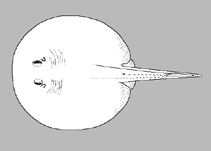
This species is distinguished from its congeners by the following set of characters: dorsal disc with dark background, with a beige or light brown, closely packed and highly convoluted vermicular pattern; one row of irregular spines on dorsal tail midline; presence of star-shaped, asymmetrical and minute dermal denticles, rarely with crown dichotomies, and concentrated over central region of disc. It is further distinguished from P. motoro (Müller & Henle, 1841) by lacking on disc ocelli formed by strong black concentric rings, a more flattened aspect of its disc; with much smaller dermal denticles, and considerably smaller eyes; from P. orbignyi (Castelnau, 1855) by lacking a dorsal reticulate pattern, presence of two angular cartilages, and lower number of total pectoral radials (modal values 97 vs. 90, respectively); from P. falkneri by having tail spines in one irregular row (instead of in 1-3 irregular rows), lower total pectoral radial count (90-93 vs. 94-100, respectively), having a proportionally much longer tail (mean values 109% vs. 93.5% of DW, respectively), by its teeth with no prominent cusps in adult males (males usually with prominent cusps in P. falkneri), and having spots on dorsal disc that are exclusively vermicular, not occurring as independent spots (many specimens with individual spots on background, these mostly circular, reniform, or oval, with diameter equal to or smaller than eye in P. falkneri) (Ref. 86911).
Body shape (shape guide): other; Cross section: flattened.
Ciclo vitale e comportamento di accoppiamento
Maturità | Riproduzione | Deposizione | Uova | Fecondità | Larve
Da Silva, J.P.C.B. and M.R. Da Carvalho, 2011. A new species of neotropical freshwater stingray of the genus Potamotrygon Garman, 1877 from the Río Madre de Díos, Peru (Chondrichthyes: Potamotrygonidae). Papéis Avulsos de Zoologia (São Paulo) 51(8):139-154. (Ref. 86911)
Stato della Lista Rossa IUCN (Ref. 130435: Version 2025-2 (Global))
Minaccia per l'uomo
Harmless
Usi umani
Strumenti
Rapporti speciali
Scarica XML
Fonti Internet
Stime basate su modelli
Indice di diversità filogenetica (Fonte Biblio.
82804): PD
50 = 0.5000 [Uniqueness, from 0.5 = low to 2.0 = high].
Bayesian length-weight: a=0.01000 (0.00244 - 0.04107), b=3.04 (2.81 - 3.27), in cm total length, based on all LWR estimates for this body shape (Ref.
93245).
Livello trofico (Fonte Biblio.
69278): 3.2 ±0.4 se; based on size and trophs of closest relatives
Vulnerabilità della pesca (Ref.
59153): High vulnerability (58 of 100).
🛈