>
Blenniiformes (Blennies) >
Blenniidae (Combtooth blennies) > Salariinae
Etymology: Parablennius: Greek, para = the side of + Greek, blennios = mucus (Ref. 45335).
Ambiente: milieu / zona climática / intervalo de profundidade / gama de distribuição
Ecologia
marinhas bentopelágico. Subtropical
Eastern Indian Ocean: Western Australia.
Tamanho / Peso / Idade
Maturidade: Lm ? range ? - ? cm
Descrição breve
Chaves de identificação | Morfologia | Morfometria
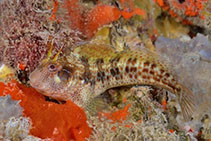
Espinhos dorsais (total) : 12; Raios dorsais moles (total) : 15 - 17; Espinhos anais: 2; Raios anais moles: 16 - 18. Segmented dorsal fin rays 16 (rarely 15 or 17); segmented anal fin rays 18 (rarely 16-17); supraorbital tentacle comprised of a long, stout main tentacle bearing 3 to 9 (rarely 9) side branches; head lateral line system with 120 to 266 pores (mean 207.4); male Western Australian species with intense spotting on lower side of head; with round light brown blotch on postorbital region bordered by a typically segmented white, dark-edged streak; numerous medium to blackish brown blotches on lower half of cheek, sides of upper lip, suborbital area, branchiostegal membranes, pectoral fin base and basal 1/3 of pectoral fin; 6 to 7 groups of elongate rows of dark blotches on upper 2/3 of body.
Body shape (shape guide): elongated; Cross section: oval.
Facultative air-breathing in the genus (Ref. 126274); Oviparous. Eggs are demersal and adhesive (Ref. 205), and are attached to the substrate via a filamentous, adhesive pad or pedestal (Ref. 94114). Larvae are planktonic, often found in shallow, coastal waters (Ref. 94114).
Ciclo de vida e comportamento de acasalamento
Maturidade | Reprodução | Desova | Ovos | Fecundidade | Larvas
Oviparous, distinct pairing (Ref. 205).
Hoese, D.F., D.J. Bray, J.R. Paxton and G.R. Allen, 2006. Fishes. In Beasley, O.L. and A. Wells (eds.) Zoological Catalogue of Australia. Volume 35 Australia: ABRS & CSIRO Publishing, 2178 p. (Ref. 75154)
Categoria na Lista Vermelha da IUCN (Ref. 130435: Version 2025-2 (Global))
Ameaça para o homem
Harmless
Utilização humana
Ferramentas
Relatórios especiais
Descarregue XML
Fontes da internet
Estimativas baseadas em modelos
Índice de diversidade filogenética (Ref.
82804): PD
50 = 0.5000 [Uniqueness, from 0.5 = low to 2.0 = high].
Bayesian length-weight: a=0.00776 (0.00354 - 0.01702), b=3.00 (2.81 - 3.19), in cm total length, based on LWR estimates for this (Sub)family-body shape (Ref.
93245).
Nível Trófico (Ref.
69278): 2.8 ±0.1 se; based on size and trophs of closest relatives
Resiliência (Ref.
120179): Elevada, tempo mínimo de duplicação da população menor que 15 meses (Preliminary K or Fecundity.).
Vulnerabilidade da pesca (Ref.
59153): Low vulnerability (10 of 100).
🛈