Classification / Noms
Noms communs | Synonymes | Catalog of Fishes(Genre, Espèce) | ITIS | CoL | WoRMS | Cloffa
>
Characiformes (Characins) >
Anostomidae (Headstanders)
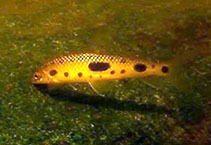
Etymology: Leporinus: Latin, lepus, leporis = rabbit (Ref. 45335); apollo: Named after the god of the sun, music and healing in Greek and Roman mythology. The extremely slender form of the new species is reminiscent of the arrow that was Apollo’s favoured weapon and predominant symbol, and the yellow cast of the body and fins and the rounded shape of the lateral markings evoke the sun that was one of Apollo’s primary aspects.
Eponymy: Apollo was the god of sun, music and healing in Greek and Roman mythology, referring to the fish’s extremely slender form that is “reminiscent of the arrow that was Apollo’s favoured weapon and predominant symbol, and the yellow cast of body and [...] (Ref. 128868), visit book page.
More on authors: Sidlauskas, Mol & Vari.
Environnement : milieu / zone climatique / profondeur / gamme de distribution
Écologie
; eau douce benthopélagique. Tropical
South America: Coppename, Corantijn, and Suriname rivers in Suriname.
Taille / Poids / Âge
Maturité: Lm ? range ? - ? cm
Max length : 13.4 cm SL mâle / non sexé; (Ref. 86822)
Description synthétique
Clés d'identification | Morphologie | Morphométrie
Rayons mous dorsaux (Total) : 12; Rayons mous anaux: 9 - 10; Vertèbres: 38 - 39. Differs from all congeners except Leporinus cylindriformis, Leporinus niceforoi, Leporinus cf. niceforoi, Leporinus ortomaculatus, and a possibly undescribed species from the Amazon drainage (Leporinus sp.) by the combination of having an extremely dorsoventrally slender body (body depth immediately anterior to the dorsal-fin origin 18-23% in SL) and a pigmentation pattern including three or four large, black spots centred along the lateral-line-scale row. Can be separated from Leporinus niceforoi, Leporinus ortomaculatus, and Leporinus sp. by having six scales in a transverse series above the lateral line (in all but one examined specimen, which has five scales in that series) versus five scales in that series in all examined specimens of Leporinus niceforoi, Leporinus ortomaculatus, and Leporinus /i> sp.;
Leporinus cf. niceforoi by body depth 18.3-22.9% in SL versus 23.3-27.3% and by the typical transverse scale count at the dorsal and pelvic fin origins of 6/5 (5/5 and 6/4 each occur once) versus a typical count of 5/4 (occasionally 5/5, once 6/4, never 6/5); Leporinus cylindriformis and Leporinus niceforoi by the presence of a small, dark spot on the body immediately ventral to the seventh, eighth, or ninth scale of the lateral line, versus the absence of such a spot in those two species; and further Leporinus cylindriformis by the possession of a dark spot centered immediately posterior to the opercle and slightly ventral to the lateralline-scale row (versus the lack of such a spot), the presence of a series of nine to 14 dark bars across the dorsal surface of the body that terminate ventrally in darker areas that form an irregular stripe situated dorsal and parallel to the lateral line scale row (versus the lack of well-developed transverse bars and absence of such dark areas), and by body width 9.7-14.0% in SL (versus 15.2%) (Ref. 86822).
Body shape (shape guide): elongated.
Distinct pairs breed on densely grown weedy places (Ref. 205).
Cycle de vie et comportement reproducteur
Maturité | Reproduction | Frai | Œufs | Fécondité | Larves
Distinct pairs breed on densely grown weedy places (Ref. 205).
Sidlauskas, B.L., J.H. Mol and R.P. Vari, 2011. Dealing with allometry in linear and geometric morphometrics: a taxonomic case study in the Leporinus cylindriformis group (Characiformes: Anostomidae) with description of a new species from Suriname. Zool. J. Linnean Soc. 162(1):103-130. (Ref. 86822)
Statut dans la liste rouge de l'IUCN (Ref. 130435: Version 2025-2 (Global))
Menace pour l'homme
Harmless
Utilisations par l'homme
Outils
Articles particuliers
Télécharger en XML
Sources Internet
Estimations basées sur des modèles
Indice de diversité phylogénétique (Réf.
82804): PD
50 = 0.5000 [Uniqueness, from 0.5 = low to 2.0 = high].
Bayesian length-weight: a=0.01023 (0.00469 - 0.02234), b=3.04 (2.86 - 3.22), in cm total length, based on LWR estimates for this Genus-body shape (Ref.
93245).
Niveau trophique (Réf.
69278): 2.5 ±0.1 se; based on size and trophs of closest relatives
Résilience (Réf.
120179): Haut, temps minimum de doublement de population inférieur à 15 mois (Preliminary K or Fecundity.).
Vulnérabilité de la pêche (Ref.
59153): Low vulnerability (10 of 100).
🛈