>
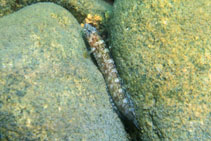
Perciformes/Zoarcoidei (Eelpouts and pricklebacks) >
Stichaeidae (Pricklebacks) > Stichaeinae
Etymology: Ernogrammus: Greek, ernos, -eos, -ous = bud, shoot, descendenat + Greek, gramma = letter, mark, signal (Ref. 45335); zhirmunskii: Named for Alexey V. Zhirmunsky (1921-2000) of the Russian Academy of Sciences, founder and director of the Institute of Marine Biology (Far Eastern Branch of the Russian Academy of
Sciences, Vladivostok), and the initiator of the Far Eastern Marine Biosphere Reserve.
Eponymy: Alexei Viktorovich Zhirmunsky (1921–2000) of the Russian Academy of Sciences was the founder and Director of the Institute of Marine Biology (Far Eastern Branch of the Russian Academy of Sciences, Vladivostok). (Ref. 128868), visit book page.
Environnement : milieu / zone climatique / profondeur / gamme de distribution
Écologie
marin démersal; profondeur 2 - 11 m (Ref. 86739). Temperate
Northwest Pacific: Russia, Sea of Japan.
Taille / Poids / Âge
Maturité: Lm ? range ? - ? cm
Max length : 6.4 cm SL mâle / non sexé; (Ref. 86739); 7.5 cm SL (female)
Description synthétique
Clés d'identification | Morphologie | Morphométrie
Épines dorsales (Total) : 41 - 42; Épines anales: 2; Rayons mous anaux: 28 - 30; Vertèbres: 44 - 47. This species is distinguished from its congeners in having 7 body sensory canals, including one short canal in the middle of belly; anal fin rays with one short rigid spine posteriormost (I 28-30 I); with one narrow white stripe between two wide black ones on the base of pelvic fin, and one dark blotch on the dorsal fin anteriorly (Ref. 86739).
Body shape (shape guide): elongated; Cross section: compressed.
This species, from visual underwater observations, occurs in rocky substrate, 2.5-11.3 m, at water temperature from 14ºC to 21ºC during July to September. It is a secretive species, and under ordinary condition it seldom leave their shelters under boulders in the daytime and usually with only the anterior part of the body exposed. During the collection, 1-3 fish were usually found under one boulder 0.3 × 0.3 m in size, the common density reached 8 fish/m2. The species is inactive at night, unlike E. hexagrammus which commonly occurs in the same rocky habitat. Specimens of the type series had average body weight 1.425 g (1.100-1.900 g), the smallest collected fish (FEMBSNR 748 juvenile SL 34 mm) had body weight of 0.350 g. Stomachs of collected specimens contained remains of shells of small mollusk Falsicingula mundana (Gastropoda: Discopoda: Falsicingulidae), remains of unidentified fish and lumps of tiny fish eggs (Ref. 86739).
Cycle de vie et comportement reproducteur
Maturité | Reproduction | Frai | Œufs | Fécondité | Larves
Markevich, A.I. and V.E. Kharin, 2011. A new species of prickleback Ernogrammus zhirmunskii (Acanthopterygii: Perciformes: Stichaeidae) from the Sea of Japan, Russia. Zootaxa 2814:59-66. (Ref. 86739)
Statut dans la liste rouge de l'IUCN (Ref. 130435: Version 2025-2 (Global))
Menace pour l'homme
Harmless
Utilisations par l'homme
Outils
Articles particuliers
Télécharger en XML
Sources Internet
Estimations basées sur des modèles
Indice de diversité phylogénétique (Réf.
82804): PD
50 = 0.6250 [Uniqueness, from 0.5 = low to 2.0 = high].
Bayesian length-weight: a=0.00380 (0.00165 - 0.00876), b=3.16 (2.96 - 3.36), in cm total length, based on LWR estimates for this (Sub)family-body shape (Ref.
93245).
Niveau trophique (Réf.
69278): 3.2 ±0.5 se; based on size and trophs of closest relatives
Résilience (Réf.
120179): Milieu, temps minimum de doublement de population : 1,4 à 4,4 années (Preliminary K or Fecundity.).
Vulnérabilité de la pêche (Ref.
59153): Low vulnerability (10 of 100).
🛈