>
Gymnotiformes (Knifefishes) >
Gymnotidae (Naked-back knifefishes) > Gymnotinae
Etymology: Gymnotus: Greek, gymnos = naked (Ref. 45335); tiquie: Named for its type locality, Rio Tiquié (Brazil); noun in apposition.
Meio ambiente: milieu / Zona climática / intervalo de profundidade / faixa de distribuição
Ecologia
; Água doce bentopelágico. Tropical
South America: Brazil (Rio Tiquié).
Tamanho / Peso / Idade
Maturidade: Lm ? range ? - ? cm
Max length : 24.0 cm TL macho/indeterminado; (Ref. 83328)
Descrição suscinta
Chaves de identificação | Morfologia | Morfometria
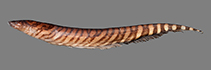
Raios anais : 210 - 265. This species is distinguished from all members of the G. pantherinus group by a unique set of morphometric, meristic, and osteological traits: its distinct color pattern in which the dark oblique pigment bands, diverse in shape and design, are divided into band-pairs along the length of the body (the band-pairs are often recurved, dorsally concave, more variable, and often reticulated in the abdominal region), and the pale inter-bands meet at the dorsal mid-line along most of the length of the body. This species shares with other members of the species group the following: presence of one (vs. two) pore in the dorsolateral portion of the preopercle (except in G. pantanal and G. anguillaris); needle-shaped (vs. conical or arrowhead-shaped) teeth on the dentary and premaxilla; a slender body, depth 5.6-10.6% HL (vs. deep 8.7-13.5%, except G. chaviro, G. curupira, G. varzea, G. chimarrao, G. maculosus, G. henni, and G. inaequilabiatus that also have a slender body). Gymnotus tiquie is most similar in overall appearance to G. cataniapo (upper Orinoco) where these two share three unique features: dark band-pairs with wavy irregular margins along the length of the body; long body cavity with 45 or more pre-caudal vertebrae; darkly pigmented membrane in the caudal region of the anal fin (Ref. 83328).
Facultative air-breathing in the genus (Ref. 126274); Specimens were collected in small, clearwater terra firme forest streams, generally no more than half a meter deep and one meter wide; dipnet was used after being stunned with the aid of barbasco (timbó), an ichthyocide prepared from the root of Lonchocarpus urucu (Leguminosae). This species was collected syntopically with Sternopygus macrurus, Eigenmannia sp. (Sternopygidae), Hypopygus lepturus, Hypopygus sp., Brachyhypopomus sp. (Hypopomidae), and the congeners G. carapo and G. coropinae (Gymnotidae). In the Rio Tiquié basin, G. tiquie and G. coropinae appear to be confined to terra firme streams while G. carapo was recorded from both terra firme streams and from the main channel of the Rio Tiquié (Ref. 83328).
Ciclo de vida ou comportamento de acasalamento
Maturidade | Reprodução | Desova | Ovos | Fecundidade | Larvas
Maxime, E.L., F.C.T. Lima and J.S. Albert, 2011. A new species of Gymnotus (Gymnotiformes: Gymnotidae) from Rio Tiquié in Northern Brazil. Copeia 2011(1):77-81. (Ref. 83328)
Status na Lista Vermelha da UICN (Ref. 130435: Version 2025-2 (Global))
Ameaça para os humanos
Harmless
Uso pelos humanos
Ferramentas
Relatórios especiais
Baixar XML
Fontes da internet
Estimativas baseadas em modelos
Índice de diversidade filogenética (Ref.
82804): PD
50 = 0.5000 [Uniqueness, from 0.5 = low to 2.0 = high].
Bayesian length-weight: a=0.00437 (0.00209 - 0.00911), b=2.98 (2.79 - 3.17), in cm total length, based on LWR estimates for this (Sub)family-body shape (Ref.
93245).
Nível Trófico (Ref.
69278): 3.3 ±0.4 se; based on size and trophs of closest relatives
Resiliência (Ref.
120179): Elevada, tempo mínimo de duplicação da população menor que 15 meses (Preliminary K or Fecundity.).
Vulnerabilidade da pesca (Ref.
59153): Low vulnerability (14 of 100).
🛈