Klassifizierung / Names
Namen | Synonyme | Catalog of Fishes(Gattung, Arten) | ITIS | CoL | WoRMS | Cloffa
>
Cyprinodontiformes (Rivulines, killifishes and live bearers) >
Poeciliidae (Poeciliids) > Poeciliinae
Etymology: Poecilia: Greek, poikilos = with a lot of colours (Ref. 45335).
Eponymy: Alessandra Sarraf Pereira was a Brazilian ichthyologist at the Biological Institute of the Federal University of Rio de Janeiro. [...] (Ref. 128868), visit book page.
More on authors: Bragança & Costa.
Umwelt: Milieu / Klimazone / Tiefenbereich / Verbreitungsgebiet
Ökologie
; süßwasser pelagisch. Tropical
South America: Parnaíba and Mearim river basins in northeastern Brazil.
Größe / Gewicht / Alter
Geschlechtsreife: Lm ? range ? - ? cm
Kurzbeschreibung
Bestimmungsschlüssel | Morphologie | Morphometrie
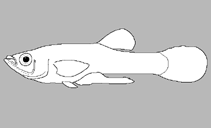
Hypothesized to be closely related to Poecilia. branneri and P. minima by sharing eight apomorphic conditions: teeth of the external rows of dentary and premaxilla conical; 5-7 teeth on the external rows of dentary and premaxilla; vomer process not longitudinally elongated; tip of gonopodial rays 3 and 4a ankylosed; dorsal fin with 8 rays in males and 7 rays in females; penultimate dorsal-fin ray of male elongated; presence of a black blotch on the posterior portion of the caudal peduncle in both sexes; middle portion of flank with vertical pale gray bars in males. Distinguished from all of its congeners by the presence of a round or slightly vertically elongated post humeral blotch (vs. slightly ventrally dislocated post humeral blotch in P. minima, vertically elongated post humeral blotch in P. parae, P. bifurca and P. picta and post-humeral blotch absent in P. branneri) (Ref. 86528).
Body shape (shape guide): fusiform / normal.
Lebenszyklus und Paarungsverhalten
Geschlechtsreife | Fortpflanzung | Ablaichen | Eier | Fruchtbarkeit | Larven
Bragança, P.H.N. and W.J.E.M. Costa, 2010. Poecilia sarrafae, a new poeciliid from the Parnaíba and Mearim river basins, northeastern Brazil (Cyprinodontiformes: Cyprinodontoidei). Ichthyol. Explor. Freshwat. 21(4):369-376. (Ref. 86528)
IUCN Rote Liste Status (Ref. 130435: Version 2025-2 (Global))
Bedrohung für Menschen
Harmless
Nutzung durch Menschen
Tools
Zusatzinformationen
Download XML
Internet Quellen
Schätzungen auf der Grundlage von Modellen
Phylogenetischer Diversitätsindex (Ref.
82804): PD
50 = 0.5000 [Uniqueness, from 0.5 = low to 2.0 = high].
Bayesian length-weight: a=0.01288 (0.00551 - 0.03009), b=3.14 (2.96 - 3.32), in cm total length, based on LWR estimates for this Genus-body shape (Ref.
93245).
Trophische Ebene (Ref.
69278): 2.6 ±0.3 se; based on size and trophs of closest relatives
Widerstandsfähigkeit (Ref.
120179): hoch, Verdopplung der Population dauert weniger als 15 Monate. (Preliminary K or Fecundity.).
Anfälligkeit der Fischerei (Ref.
59153): Low vulnerability (10 of 100).
🛈