>
Perciformes/Uranoscopoidei (Sand dwellers) >
Uranoscopidae (Stargazers)
Etymology: Kathetostoma: Greek, kathetos, -on = lime + Greek, stoma = mouth (Ref. 45335); binigrasella: The specific name binigrasella, from the Latin bi for ‘two’, nigra for ‘dark’ and sella for ‘saddle’ refers to the broad dark brown saddle-like bands dorsally on the body that are obvious features distinguishing this species from its New Zealand congener.
Meio ambiente: milieu / Zona climática / intervalo de profundidade / faixa de distribuição
Ecologia
marinhas bentopelágico; intervalo de profundidade 10 - 500 m (Ref. 86516), usually 100 - 300 m (Ref. 86516). Temperate
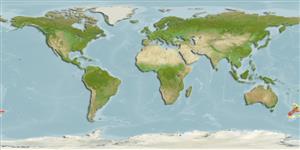
Pacific Ocean: endemic to New Zealand.
Tamanho / Peso / Idade
Maturidade: Lm ? range ? - ? cm
Max length : 56.0 cm SL macho/indeterminado; (Ref. 86516)
Descrição suscinta
Chaves de identificação | Morfologia | Morfometria
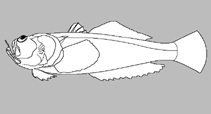
Raios dorsais (total) : 15 - 17; Raios anais : 14 - 16; Vértebras: 30 - 31. Head and body broad, head width 1.2-1.7 times its length, covered with tiny blunt knobs in juveniles to almost smooth in adults; mouth with several prominent canines between smaller canines; chin smooth; ventral margin of preopercle with four spine-like processes; anterior end of isthmus with a pair of prominent forward directed spines; prominent cleithral spine sheathed with skin above pectoral fin base; 17-19 gill rakers on first arch in the form of patches of fine teeth, patches broad, about six to ten teeth across patches, not in distinct rows, innermost teeth rather short; dorsal fin of moderate length, its base 43-66% of predorsal length; pelvic fins large, their length 23-28% SL; body whitish below usually with two broad, vertical, dark-brown, variously distinct bands or saddles across back, most distinct in juveniles and small adults (Ref. 86516).
Found on sand or mud bottoms (Ref. 86516).
Ciclo de vida ou comportamento de acasalamento
Maturidade | Reprodução | Desova | Ovos | Fecundidade | Larvas
Gomon, M.F. and C.D. Roberts, 2011. A second New Zealand species of the stargazer genus Kathetostoma (Trachinoidei: Uranoscopidae). Zootaxa 2776:1-12. (Ref. 86516)
Status na Lista Vermelha da UICN (Ref. 130435: Version 2025-2 (Global))
Ameaça para os humanos
Harmless
Uso pelos humanos
Ferramentas
Relatórios especiais
Baixar XML
Fontes da internet
Estimativas baseadas em modelos
Temperatura preferida (Ref.
123201): 10.2 - 14.5, mean 13 °C (based on 27 cells).
Índice de diversidade filogenética (Ref.
82804): PD
50 = 0.5020 [Uniqueness, from 0.5 = low to 2.0 = high].
Bayesian length-weight: a=0.00631 (0.00265 - 0.01501), b=3.11 (2.90 - 3.32), in cm total length, based on LWR estimates for this (Sub)family-body shape (Ref.
93245).
Nível Trófico (Ref.
69278): 4.4 ±0.7 se; based on size and trophs of closest relatives
Resiliência (Ref.
120179): Baixo, tempo mínimo de duplicação da população 4,5 - 14 anos (Preliminary K or Fecundity.).
Vulnerabilidade da pesca (Ref.
59153): Moderate to high vulnerability (47 of 100).
🛈