Elasmobranchi (squali e razze) (sharks and rays) >
Torpediniformes (Electric rays) >
Platyrhinidae (Fanrays)
Etymology: Platyrhina: Greek, platys = flat + Greek, rhinos = nose. It is the same voice used for the Mammalian division made in Primates (Ref. 45335); tangi: Named for Chinese ichthyologist D.-S. Tang.
Eponymy: D-S Tang was a Chinese ichthyologist at the University of Amoy, who was active in the 1930s. [...] (Ref. 128868), visit book page.
Ambiente: milieu / zona climatica / distribuzione batimetrica / gamma di distribuzione
Ecologia
marino pelagic-neritic. Temperate; 40°N - 17°N, 106°E - 141°E (Ref. 114953)
Northwest Pacific: southern Japan (except the Ryukyu and Ogasawara Islands), southern Korea, China, Taiwan and northern Vietnam.
Lunghezza alla prima maturità / Dimensione / Peso / Età
Maturità: Lm ?, range 42 - ? cm
Max length : 68.0 cm TL maschio/sesso non determinato; (Ref. 86259); 63.9 cm TL (female)
Breve descrizione
Chiavi di identificazione | Morfologia | Morfometria
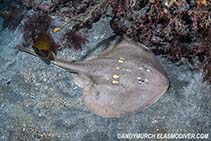
This species is distinguished from its congeners in having the following set of characters: a row of thorns (weakly hooked, sometimes tubercle-like) on mid-dorsum of tail; no thorns on the anterior part of scapular region; thorns on the orbital, nape and scapular regions encircled by light yellow or white pigment; dorsal surface covered with minute and some clearly larger dermal denticles (coarse to touch) (Ref. 86259).
Body shape (shape guide): other.
From studies on vertebral centra, it has been suggested that females attain a greater asymptotic total length (55.58 cm TL) and grew more slowly than males (45.52 cm TL) (based on specimens from Ariake Bay, western Kyushu Island, Japan). The maximum ages observed were 5 years for males and 12 years for females. Furthermore, it was also reported that females reached sexual maturity at a greater size than males (total length at 50% sexual maturity: males, 39.3 cm; females, 42.1cm). Parturition occurred from August to November followed immediately by mating, ovulation and fertilization. Largest specimen yet recorded (USNM 51295, 68.0 cm TL, Tokyo, sex unknown) with the largest specimens examined and collected from the Hyuga Nada Sea to be 63.9 cm TL for female, and 52.5 cm TL for male; however, the species is likely to grow larger than ca. 70.0 cm TL according to local Miyazaki fishermen (Ref. 86259).
Ciclo vitale e comportamento di accoppiamento
Maturità | Riproduzione | Deposizione | Uova | Fecondità | Larve
Iwatsuki, Y., K. Miyamoto, K. Nakaya and J. Zhang, 2011. A review of the genus Platyrhina (Chondrichthys: Platyrhinidae) from the northwestern Pacific, with descriptions of two new species. Zootaxa 2738:26-40. (Ref. 86259)
Stato della Lista Rossa IUCN (Ref. 130435: Version 2025-2 (Global))
Minaccia per l'uomo
Harmless
Usi umani
Strumenti
Rapporti speciali
Scarica XML
Fonti Internet
Stime basate su modelli
Indice di diversità filogenetica (Fonte Biblio.
82804): PD
50 = 0.5938 [Uniqueness, from 0.5 = low to 2.0 = high].
Bayesian length-weight: a=0.01000 (0.00244 - 0.04107), b=3.04 (2.81 - 3.27), in cm total length, based on all LWR estimates for this body shape (Ref.
93245).
Livello trofico (Fonte Biblio.
69278): 3.4 ±0.4 se; based on size and trophs of closest relatives
Vulnerabilità della pesca (Ref.
59153): Moderate to high vulnerability (47 of 100).
🛈