Classificação / Nomes
Nomes comuns | Sinônimos | Catalog of Fishes(Gênero, Espécies) | ITIS | CoL | WoRMS | Cloffa
>
Cichliformes (Cichlids, convict blennies) >
Cichlidae (Cichlids) > Pseudocrenilabrinae
Etymology: Sarotherodon: Greek, saros, -ou = sawdust + Greek, ther = animal * Greek, odous = teeth (Ref. 45335); knauerae: Named for Mrs. Barbara Knauer, former technician at the Max-Planck-Institut (Seewiesen), who substantially supported UKS as a technician and friend during his PhD studies (Ref. 86429).
Eponymy: Barbara Knauer was a technician at the Max Planck Society at Seewiesen, Germany. According to the etymology, she “…substantially supported [the third author Dr Ulrich Schliewen] as a technician and friend” during his Ph.D. studies. (Ref. 128868), visit book page.
Meio ambiente: milieu / Zona climática / intervalo de profundidade / faixa de distribuição
Ecologia
; Água doce bentopelágico, usually 0 - 3 m (Ref. 86429). Tropical; 6°N - 5°N, 8°E - 9°E
Africa: Lake Ejagham in Cameroon (Ref. 86429).
Tamanho / Peso / Idade
Maturidade: Lm ? range ? - ? cm
Max length : 7.7 cm SL macho/indeterminado; (Ref. 86429)
Descrição suscinta
Chaves de identificação | Morfologia | Morfometria
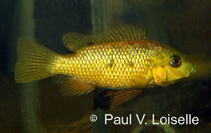
Espinhos dorsais (total) : 15 - 16; Raios dorsais (total) : 13 - 14; Espinhos anais: 3; Raios anais : 10 - 12. Diagnosis: Sarotherodon knauerae is distinguished from all congeners by the possession of an inflated second pharyngobranchial element in the upper pharyngeal jaw, and is one of the smallest known Sarotherodon, reaching a maximum observed size of only 75.2 mm standard length (Ref. 86429). It further differs from sympatric Sarotherodon lamprechti in possessing a terminal, vs. prognathous, mouth; scaled pectoral fin base; short pectoral fins ending at or in front of anus, vs. reaching first anal fin-spine or beyond; and short pelvic fins ending well in front of anus, vs. reaching anus; additionally, S. knauerae possesses a shorter upper lip, 19.1–25.4% of head length vs. 22.5–28.4%, a higher total gill raker count, 24–30 vs. 20–25, and larger eyes, 24.0–31.2% of head length vs. 20.4–29.2% (Ref. 86429). It is distinguished from neighbouring riverine S. galilaeus populations from Cross, Wouri and Lower Niger rivers, S. g. multifasciatus and S. g. borkuanus by a shorter anal fin, 12.0–14.6% of standard length vs. 15.3–19.3%, 15.1–25.7% and 13.4–17.9% respectively; and narrower caudal peduncle, 12.8–14.5% of standard length vs. 16.0–18.7%, 13.9–18.3% and 13.6–17.4% respectively (Ref. 86429). It differs from S. caroli and S. linnellii in higher gill raker counts, 24–30 vs. 18–20 and 15–18 respectively; from S. g. sanagaensis in a lower preorbital depth, 17.8–23.0% of head length vs. 25.0–27.8%; and from S. g. boulengeri and riverine Sarotherodon galilaeus in a lower body depth, 36.5–43.9% of standard length vs. 44.5–50.0% and 43.5–44.6% respectively (Ref. 86429). Finally it differs from all other Lake Barombi Mbo Sarotherodon in a higher number of dorsal fin-rays, 13-14 vs. 10–12 (Ref. 86429).
Body shape (shape guide): short and / or deep.
A gregarious, predominantly benthic species found in Lake Ejagham; present in all habitats and at all depths, but most common inshore, to 3 m, than in deeper zones (Ref. 86429). The species is a detritivore, taking detritus from both soft and hard substrates as well as from the water surface (Ref. 86429). Presence of numerous juveniles in the dry season, January-February, suggests that reproduction takes place predominantly in the rainy season, August-September (Ref. 86429). Males do not vigorously defend courtship territories with a bower; in aquaria Sarotherodon knauerae are maternal mouth brooders (Ref. 86429).
Ciclo de vida ou comportamento de acasalamento
Maturidade | Reprodução | Desova | Ovos | Fecundidade | Larvas
In aquaria Sarotherodon knauerae are maternal mouth brooders (Ref. 86429).
Neumann, D., M.L.J. Stiassny and U.K. Schliewen, 2011. Two new sympatric Sarotherodon species (Pisces: Cichlidae) endemic to Lake Ejagham, Cameroon, west-central Africa, with comments on the Sarotherodon galilaeus species complex. Zootaxa 2765:1-20 (Ref. 86429)
Status na Lista Vermelha da UICN (Ref. 130435: Version 2025-2 (Global))
Ameaça para os humanos
Harmless
Uso pelos humanos
Ferramentas
Relatórios especiais
Baixar XML
Fontes da internet
Estimativas baseadas em modelos
Índice de diversidade filogenética (Ref.
82804): PD
50 = 0.5001 [Uniqueness, from 0.5 = low to 2.0 = high].
Bayesian length-weight: a=0.01905 (0.00846 - 0.04293), b=3.01 (2.82 - 3.20), in cm total length, based on LWR estimates for this (Sub)family-body shape (Ref.
93245).
Nível Trófico (Ref.
69278): 2.5 ±0.2 se; based on size and trophs of closest relatives
Vulnerabilidade da pesca (Ref.
59153): Low vulnerability (10 of 100).
🛈