Classificação / Nomes
Nomes comuns | Sinônimos | Catalog of Fishes(Gênero, Espécies) | ITIS | CoL | WoRMS | Cloffa
>
Cichliformes (Cichlids, convict blennies) >
Cichlidae (Cichlids) > Pseudocrenilabrinae
Etymology: Maylandia: In honour of Hans J. Mayland, German ictiologist (Ref. 45335); mossambica: The specific epithet, mossambicus, refers to the area where the species is native; an adjective (Ref. 86409).
Eponymy: Hans-Joachim Mayland (1928–2004) was a German ichthyologist, aquarist, photographer and writer. [...] (Ref. 128868), visit book page.
Meio ambiente: milieu / Zona climática / intervalo de profundidade / faixa de distribuição
Ecologia
; Água doce bentopelágico. Tropical; 13°S - 14°S, 34°E - 35°E
Africa: Lake Malawi in Mozambique (Ref. 86490).
Tamanho / Peso / Idade
Maturidade: Lm ? range ? - ? cm
Max length : 8.0 cm SL macho/indeterminado; (Ref. 86409)
Descrição suscinta
Chaves de identificação | Morfologia | Morfometria
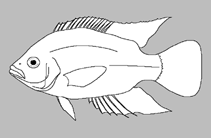
Espinhos dorsais (total) : 16 - 18; Raios dorsais (total) : 8 - 10; Espinhos anais: 3; Raios anais : 7 - 9. Diagnosis: A moderately-sloped head and bicuspid teeth in the outer row of the jaws place this species in Maylandia (Ref. 86409). Male M. mossambica from Chiloelo are distinguished from those of all other members of Maylandia by the absence of a black submarginal band in the dorsal and by black streaks in the caudal and in the posterior portion of the dorsal fin; male M. mossambica from Chinuni are distinguished from those of all other Maylandia by the absence of a black submarginal band in the dorsal and by a narrow black submarginal band in the anal fin; male M. mossambica from Lumessi are distinguished from all other Maylandia, except M. aurora, M. chrysomallos, and M. xanthos by the absence of a black submarginal band in the dorsal, a yellow ventral half of the head, breast, and dorsal fin, and a light-blue nape; male M. mossambica from Lumessi population differ from those of M. chrysomallos by a yellow dorsal fin which is light-blue in the latter (Ref. 86409). Maylandia mossambica differs from M. aurora by more vertical bars below the dorsal, 7–9 vs. 6, and from M. xanthos by a shorter lower jaw, 27.9–33.8% of head length vs. 34.6–36.7% (Ref. 86409). Based on the colour pattern, female M. mossambica cannot reliably be distinguished from those of most other members of the Aurora group but have 7 or 8 bars below the dorsal fin vs. 6 bars in M. aurora (Ref. 86409).
Body shape (shape guide): fusiform / normal.
Ciclo de vida ou comportamento de acasalamento
Maturidade | Reprodução | Desova | Ovos | Fecundidade | Larvas
Ciccotto, P.J., A. Konings and J.R. Stauffer Jr., 2011. Descriptions of five new species in the genus Metriaclima (Teleostei: Cichlidae) from Lake Malaŵi, Africa. Zootaxa 2738:1-25. (Ref. 86409)
Status na Lista Vermelha da UICN (Ref. 130435: Version 2025-2 (Global))
Ameaça para os humanos
Harmless
Uso pelos humanos
Ferramentas
Relatórios especiais
Baixar XML
Fontes da internet
Estimativas baseadas em modelos
Índice de diversidade filogenética (Ref.
82804): PD
50 = 0.5000 [Uniqueness, from 0.5 = low to 2.0 = high].
Bayesian length-weight: a=0.01445 (0.00671 - 0.03113), b=2.99 (2.82 - 3.16), in cm total length, based on LWR estimates for this (Sub)family-body shape (Ref.
93245).
Nível Trófico (Ref.
69278): 2.3 ±0.1 se; based on size and trophs of closest relatives
Vulnerabilidade da pesca (Ref.
59153): Low vulnerability (10 of 100).
🛈