Ambiente: milieu / zona climatica / distribuzione batimetrica / gamma di distribuzione
Ecologia
marino batidemersale; distribuzione batimetrica 1036 - 1157 m (Ref. 86286). Polar; 71°S - 72°S, 179°W - 178°W (Ref. 92304)
Southern Ocean, East Antarctica: Ross Sea.
Dimensione / Peso / Età
Maturità: Lm ? range ? - ? cm
Max length : 21.9 cm SL maschio/sesso non determinato; (Ref. 86286); 26.2 cm SL (female)
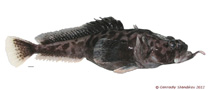
Spine dorsali (totale) : 2; Raggi dorsali molli (totale) : 27 - 28; Raggi anali molli: 17 - 18; Vertebre: 37. This dorsally-spotted and short-barbeled species is distinguished from other in 'mentella' group by this set of characters: a short (about 8-12% SL) bicolored mental barbel with uniformly dorsally dark-pigmented or spotted stem and rather long (65-68% of barbel length), inexpressive (barely wider than stem), light (creamy, whitish or light-orange in live specimens) and pointed terminal expansion, reaching nostrils or anterior edge of orbit in backward extended mode over the snout with mouth closed; terminal expansion composed of low, densely distributed folds with serrated or scalloped ridges and rosettes of leaf-like processes; lower jaw evidently protruding with visible teeth on symphysis when mouth closed; interorbital distance wide (about 7% SL); second dorsal fin with straight (not sinuous distally) rays, medium in height within males of the genus (about 21% SL), with conspicuous blackish-colored anterior elevated lobe, dark basally and lightish or somewhat variegated distally in posterior part; dorsal surface of head and area anterior to first dorsal fin covered by dark-brown spots and irregular markings; breast and belly dark-brown and blackish, both lacking in evident dark sharp spots or markings; mandibular and maxillar oral valves light or light-brownish; caudal and pectoral fins dark or blackish anteriorly, sometime with several inconspicuous stripes, and uniformly light in posterior narrow margin, anal and pelvic (both sides) fins blackish basally and light distally (Ref. 92304).
Body shape (shape guide): elongated; Cross section: other (see remarks).
Deep-water species collected by bottom long-line at depths 1036-1163 m by hooks. Visual observations of both type specimens, which were keeping alive in container filled with marine water, demonstrate the maintaining of the mental barbel in a horizontal position parallel to the ground when fishes were immovable. In swimming fishes, the mental barbel was pushed back over or alongside the snout by flowing water. P. brevibarbata evidently belongs to the mostly predatory species, which also opportunistically feeds as necrophage. The stomach of the female, captured 20 January 2010, contained (besides the bait, giant Peruvian squid, Dosidicus gigas) the remains of a large crustacean, probably Antarctic shrimp, Notocrangon antarcticus. State of ovaries with traces of recent spawning corresponds to early SGM VI-III, GSI 1.3. The length, width and depth of the left ovary attain about 44, 18 and 6.5 mm correspondently. The liver fills in length about 1/3 of the abdominal cavity; hepatosomatic index reaches 1.6 (Ref. 92304).
Ciclo vitale e comportamento di accoppiamento
Maturità | Riproduzione | Deposizione | Uova | Fecondità | Larve
Balushkin, A.V., A.F. Petrov and V.G. Prutko, 2010. Pogonophyrne brevibarbata sp. nov. (Artedidraconidae, Notothenioidei, Perciformes) -a new species of toadlike plunderfish from the Ross Sea, Antarctica. Proc. Zool. Institute Russian Acad. Sci. 314(4):381-386. (Ref. 86286)
Stato della Lista Rossa IUCN (Ref. 130435: Version 2025-2 (Global))
Minaccia per l'uomo
Harmless
Usi umani
Pesca: di nessun interesse
Strumenti
Rapporti speciali
Scarica XML
Fonti Internet
Stime basate su modelli
Indice di diversità filogenetica (Fonte Biblio.
82804): PD
50 = 0.5000 [Uniqueness, from 0.5 = low to 2.0 = high].
Bayesian length-weight: a=0.00513 (0.00244 - 0.01080), b=3.13 (2.95 - 3.31), in cm total length, based on LWR estimates for this (Sub)family-body shape (Ref.
93245).
Livello trofico (Fonte Biblio.
69278): 3.3 ±0.5 se; based on size and trophs of closest relatives
Vulnerabilità della pesca (Ref.
59153): Low vulnerability (22 of 100).
🛈