Classification / Noms
Noms communs | Synonymes | Catalog of Fishes(Genre, Espèce) | ITIS | CoL | WoRMS | Cloffa
>
Ovalentaria/misc (Various families in series Ovalentaria) >
Pomacentridae (Damselfishes) > Pomacentrinae
Etymology: Pomacentrus: Greek, poma, -atos = cover, operculum + Greek, kentron = sting (Ref. 45335); cheraphilus: Named for its predilection for silty habitats; name from Greek meaning silt lover.
Environnement : milieu / zone climatique / profondeur / gamme de distribution
Écologie
marin récifal; profondeur 10 - 18 m (Ref. 86257). Tropical
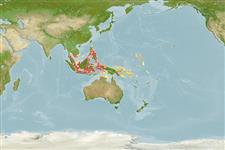
Western Pacific: Brunei and the Philippines.
Taille / Poids / Âge
Maturité: Lm ? range ? - ? cm
Max length : 6.1 cm SL mâle / non sexé; (Ref. 86257)
Description synthétique
Clés d'identification | Morphologie | Morphométrie
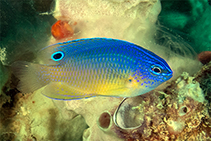
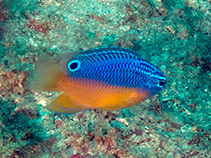
Épines dorsales (Total) : 13; Rayons mous dorsaux (Total) : 13 - 14; Rayons mous anaux: 13 - 15. This species is distinguished by this set of characters: D XIII, 13-14; A 13-15; pectoral rays 17-18; tubed lateral-line scales 17-19; total gill rakers on the first branchial arch 19-21; yellow juvenile phase with blue stripes on the upper head and adjacent anterodorsal portion of the body; light grey to dark greyish brown adult phase with a dark-edged greenish spot just below lateral line origin (Ref. 86257).
Body shape (shape guide): short and / or deep; Cross section: compressed.
Adults inhabit silty reefs around coral and rock outcrops (Ref. 86257). Oviparous, distinct pairing during breeding (Ref. 205). Eggs are demersal and adhere to the substrate (Ref. 205). Males guard and aerate the eggs (Ref. 205).
Cycle de vie et comportement reproducteur
Maturité | Reproduction | Frai | Œufs | Fécondité | Larves
Oviparous, distinct pairing during breeding (Ref. 205). Eggs are demersal and adhere to the substrate (Ref. 205). Males guard and aerate the eggs (Ref. 205).
Allen, G.R., M.V. Erdmann and V.V. Hilomen, 2011. A new species of damselfish (Pomacentrus:Pomacentridae) from Brunei and the Philippines. aqua, Int. J. Ichthyol. 17(1):35-42. (Ref. 86257)
Statut dans la liste rouge de l'IUCN (Ref. 130435: Version 2025-2 (Global))
Menace pour l'homme
Harmless
Utilisations par l'homme
Outils
Articles particuliers
Télécharger en XML
Sources Internet
Estimations basées sur des modèles
Température préférée (Réf.
123201): 28.5 - 29.2, mean 28.9 °C (based on 662 cells).
Indice de diversité phylogénétique (Réf.
82804): PD
50 = 0.5000 [Uniqueness, from 0.5 = low to 2.0 = high].
Bayesian length-weight: a=0.02399 (0.01134 - 0.05074), b=2.98 (2.81 - 3.15), in cm total length, based on LWR estimates for this Genus-body shape (Ref.
93245).
Niveau trophique (Réf.
69278): 2.7 ±0.3 se; based on size and trophs of closest relatives
Résilience (Réf.
120179): Haut, temps minimum de doublement de population inférieur à 15 mois (Preliminary K or Fecundity.).
Vulnérabilité de la pêche (Ref.
59153): Low vulnerability (10 of 100).
🛈