Klassifizierung / Names
Namen | Synonyme | Catalog of Fishes(Gattung, Arten) | ITIS | CoL | WoRMS | Cloffa
>
Aulopiformes (Grinners) >
Paraulopidae (Cucumber fishes)
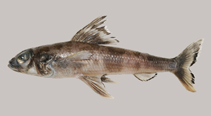
Etymology: Paraulopus: Paraulopus refers to a taxon related to Aulopus, both being included in the Aulopiformes; balteatus: Name from Latin meaning 'belted or banded’, referring to the distinctive broad brown bands on
the sides of the body in this species.
Umwelt: Milieu / Klimazone / Tiefenbereich / Verbreitungsgebiet
Ökologie
seewasser pelagic-oceanic; tiefenbereich 300 - 800 m (Ref. 86263). Deep-water
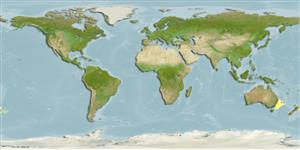
Southwest Pacific: Tasman Sea at 30°35°S, from Browns Mount southeast of Botany Bay, New South Wales, to the Three Kings Ridge just north of the northern boundary of New Zealand’s EEZ.
Größe / Gewicht / Alter
Geschlechtsreife: Lm ? range ? - ? cm
Max length : 32.0 cm SL Männchen/unbestimmt; (Ref. 86263)
Kurzbeschreibung
Bestimmungsschlüssel | Morphologie | Morphometrie
Rückenflossenweichstrahlen (insgesamt) : 11; Afterflossenweichstrahlen: 8 - 9; Wirbelzahl: 48. This species is distinguished by the following characters: A 8-9; pectoral fin rays 19; vertebrae 48; predorsal scales 19-24; scales above lateral line 5.5; pelvic fin large, length 22.8-28.4% SL, larger in males than females, inner lobe much shorter than outer lobe, ratio of lengths of outer lobe to inner 1.7-2.1; two prominent broad brown bands posterior to dorsal fin on sides of body; broad black marginal stripe covering distal third of dorsal fin with distinct broad white submarginal stripe; distal third of upper lobe of caudal fin with white marginal band and black submarginal band, while ventral lobe with black marginal band; buccal cavity pigmented black forward to jaws; males with black anal fin margin anteriorly and distally, females lack dark margins (Ref. 86263).
Body shape (shape guide): elongated.
The absence from trawl collections may infer that this species may prefer hard-bottom habitat, which is usually avoided by trawl fishers. Also, the fact that this species are taken with hook and line suggests that it is carnivorous. Individuals probably rest on their substantial pelvic fins waiting for potential prey to come to them, a behaviour common to a number of other members of the order (Ref. 86263).
Lebenszyklus und Paarungsverhalten
Geschlechtsreife | Fortpflanzung | Ablaichen | Eier | Fruchtbarkeit | Larven
Gomon, M.F., 2010. A new species of Paraulopus (Aulopiformes: Paraulopidae) from seamounts of the Tasman Sea. Memoirs of Museum Victoria 67:15-18. (Ref. 86263)
IUCN Rote Liste Status (Ref. 130435: Version 2025-2 (Global))
Bedrohung für Menschen
Harmless
Nutzung durch Menschen
Tools
Zusatzinformationen
Download XML
Internet Quellen
Schätzungen auf der Grundlage von Modellen
Bevorzugte Temperatur (Ref.
123201): 6.4 - 11.7, mean 8.8 °C (based on 19 cells).
Phylogenetischer Diversitätsindex (Ref.
82804): PD
50 = 0.5001 [Uniqueness, from 0.5 = low to 2.0 = high].
Bayesian length-weight: a=0.00389 (0.00180 - 0.00842), b=3.12 (2.94 - 3.30), in cm total length, based on all LWR estimates for this body shape (Ref.
93245).
Trophische Ebene (Ref.
69278): 4.2 ±0.7 se; based on size and trophs of closest relatives
Anfälligkeit der Fischerei (Ref.
59153): Low to moderate vulnerability (29 of 100).
🛈