Taxonomic Remarks
Commonly misidentified as Aplocheilichthys macrophthalmus in scientific literature (Ref. 81647).
Miljö: miljö / Klimatzon / djupintervall / distributionsområde
Ekologi
; sötvatten bentopelagisk; pH range: 6.0 - 8.0; dH range: 5 - 12; ej vandrande. Tropical; 22°C - 28°C (Ref. 13371)
Africa: coastal plains of southern Togo, southern Benin and southern Nigeria (Ref. 57259, 81647); also coastal plains of western and southwestern Cameroon (Ref. 81647).
Storlek / Vikt / Ålder
Könsmognad: Lm ? range ? - ? cm
Max length : 4.0 cm TL hane/ej könsbestämd; (Ref. 27139)
Taggstrålar i ryggfenan (totalt) : 0; Mjukstrålar i ryggfenan (totalt) : 6 - 9; Taggstrålar i analfenan: 0; Mjukstrålar i analfenan: 10 - 13. Diagnosis: Small ‘Lampeye’ species with relatively long fins; dorsal and anal fins pointed, caudal fin truncated; adult males with long ventral fins that may reach to the 5th or 6th anal fin ray; dorsal fin with 6-9 rays, anal fin with 10-13 rays; displacement between the dorsal and anal fins 1/7-9; scales on mid-longitudinal series 26-29 (Ref. 57259).
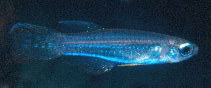
Colouration: Male colouration: translucent grey to pale olive overall colour with two longitudinal lines, consisting of large, light blue, blue-green or green iridescent spots, on the lower half of the body; upper line just below mid-body, lower line parallel to the lower body profile; a third, shorter line of iridescent spots may be present between the two prominent lines; dorsal and anal fins are pale olive to yellow, occasionally with an irregular pattern of red or white spots; the margins of these fins are usually marked by an intensification of the fin colour, although a white or orange-red margin may also be present; the pattern of the caudal fin varies on population level and is yellow to pale olive with light blue iridescent spots; an irregular pattern of yellow, orange or red spots is usually present on the caudal fin and the margin may be white, yellow or orange-red (Ref. 57259). Female colouration: translucent grey to pale olive with some light blue iridescent spots on the sides arranged in horizontal lines; the scales on the back and upper parts of the sides usually have narrow brown margins; all fins are colourless (Ref. 57259). Both sexes have a strongly reflective light blue spot in the upper part of the eye iris (Ref. 57259).
Body shape (shape guide): fusiform / normal.
Found in small rivers and brooks in the swampy primary and secondary rainforest on the coastal plains (Ref. 3788, 57259). It feeds on worms, crustaceans and insects (Ref. 7020). It is not a seasonal killifish and very difficult to maintain in aquarium (Ref. 27139).
Livscykel och parningsbeteende
Könsmognad | Reproduktion | Lek | Ägg | Fekunditet | Larver
Van Der Zee, J.R., T. Woeltjes and R.H. Wildekamp, 2008. Poeciliidae. p. 48-79. In M.L.J. Stiassny, G.G. Teugels and C.D. Hopkins (eds.) The fresh and brackish water fishes of Lower Guinea, West-Central Africa. Volume II. Collection Faune et Flore tropicales 42. Institut de Recherche pour le Développement, Paris, France, Muséum National d’Histoire Naturelle, Paris, France, and Musée Royal de l’Afrique Centrale, Tervuren, Belgium. 603 pp. (Ref. 81647)
Status på IUCN:s rödlista (Ref. 130435: Version 2025-2 (Global))
Hot mot människor
Harmless
Mänskliga användningsområden
Akvarium: Kommersiell
Verktyg
Särskilda rapporter
Ladda ner XML
Internet-källor
Uppskattningar baserade på modeller
Index för fylogenetisk mångfald (Ref.
82804): PD
50 = 0.5156 [Uniqueness, from 0.5 = low to 2.0 = high].
Bayesian length-weight: a=0.00562 (0.00224 - 0.01412), b=3.07 (2.85 - 3.29), in cm total length, based on LWR estimates for this (Sub)family-body shape (Ref.
93245).
Trofisk nivå (Ref.
69278): 3.2 ±0.4 se; based on size and trophs of closest relatives
Sårbarhet i fisket (Ref.
59153): Low vulnerability (10 of 100).
🛈