Classificação / Nomes
Nomes comuns | Sinónimos | Catalog of Fishes(Género, Espécies) | ITIS | CoL | WoRMS | Cloffa
>
Cichliformes (Cichlids, convict blennies) >
Cichlidae (Cichlids) > Pseudocrenilabrinae
Etymology: ejagham: The species name ejagham refers both to Lake Ejagham as well as to the Ejagham people, whose major sacred site is Lake Ejagham; a noun in apposition (Ref. 85854).
Ambiente: milieu / zona climática / intervalo de profundidade / gama de distribuição
Ecologia
; Água doce bentopelágico. Tropical
Africa: Lake Ejagham in Cameroon (Ref. 85854).
Tamanho / Peso / Idade
Maturidade: Lm ? range ? - ? cm
Max length : 20.0 cm SL macho/indeterminado; (Ref. 85854)
Descrição breve
Chaves de identificação | Morfologia | Morfometria
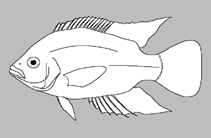
Espinhos dorsais (total) : 15 - 16; Raios dorsais moles (total) : 10 - 12; Espinhos anais: 3; Raios anais moles: 8 - 10. Diagnosis: Coptodon ejagham differs from Tilapia species, except Coelotilapia joka and Congolapia bilineata, and all members of the genus Coptodon in tricuspid, rarely quadricuspid, pharyngeal teeth in the posterior two rows of lower pharyngeal jaw (Ref. 85854). It differs from Coelotilapia joka in more gill rakers on first ceratobranchial, 9-10 vs. 6-8; from Congolapia bilineata in not having a densely scaled caudal fin; it differs from Coptodon walteri, C. rendalli, C. congica and C. dageti in lower body depth, 33.8-40.6% of standard length vs. 41.4-51.3%; from C. cameronensis in lesser number of dorsal rays, 10-12 vs. 13-14; from C. kottae in narrower interorbital width, 9.2-12.2% of standard length vs. 12.4-14.0%; from C. imbriferna in shorter head length, 32.6-39.7% of standard length vs. 40.1-42.6%; from C. thysi in higher number of gill rakers on first ceratobranchial, 9-10 vs. 7-8; from C. snyderae in longer snout length, 13.5-16.9% of standard length vs. 11.3-13.3%; from C. bakossiorum in higher cheek depth, 12.0-15.4% of standard length vs. 8.7-11.2%; from C. bythobates in shorter caudal peduncle length, 12.6-15.7% of standard length vs. 15.9-17.5%; from C. guineensis, C. margaritacea, C. discolor, C. tholloni, C. flava, and C. gutturosa in a lower caudal peduncle depth, 13.0-15.1% of standard length vs. 15.2-19.2%; from C. ismailiaensis, C. camerunensis, C. coffea, C. louka, and C. nyongana in greater lower jaw length, 12.4-16.2% of standard length vs. 7.8-12.2%; and from C. bemini in robust, non-spatulate outer row jaw teeth, vs. gracile spatulate teeth (Ref. 85854). It differs from C. deckerti in shorter eye length, 6.2-8.4% of standard length vs. 8.5-10.7%; from C. nigrans in flank scales with dark scale margins and a light centre, especially on scales below the lateral line, vs. dark square-shaped blotches at base of each flank scale, filled or with a light coloured window at centre of blotch; and from C. fusiforme in greater snout length, 13.5-16.9% of standard length vs. 10.3-13.3% (Ref. 85854). Coptodon spongotroktis is distinguishable by combination of characters: interorbital width, lower jaw length and caudal peduncle length; C. zillii is distinguished by a combination of characters: anal spine length, length of last dorsal spine, snout length, lower jaw length, caudal peduncle depth and head length (Ref. 85854).
Body shape (shape guide): fusiform / normal.
Pairs breed exclusively in the shallow inshore region above 2 m; pairs excavate large nest-pits under large branches or logs (Ref. 85854). Non-breeding Coptodon ejagham are moving solitarily and are and appear to permanently scan their environment for prey while swimming permanently without a hast, and rarely being motionless (Ref. 85854). Observations suggest that this species are predators of small fish, mostly juvenile cichlids (Ref. 85854).
Ciclo de vida e comportamento de acasalamento
Maturidade | Reprodução | Desova | Ovos | Fecundidade | Larvas
Dunz, A.R. and U.K. Schliewen, 2013. Molecular phylogeny and revised classification of the haplotilapiine cichlid fishes formerly referred to as "Tilapia". Mol. Phylogenet. Evol. 68(1):64-80. (Ref. 93285)
Categoria na Lista Vermelha da IUCN (Ref. 130435: Version 2025-2 (Global))
Ameaça para o homem
Harmless
Utilização humana
Ferramentas
Relatórios especiais
Descarregue XML
Fontes da internet
Estimativas baseadas em modelos
Índice de diversidade filogenética (Ref.
82804): PD
50 = 0.5000 [Uniqueness, from 0.5 = low to 2.0 = high].
Bayesian length-weight: a=0.01905 (0.00846 - 0.04293), b=3.01 (2.82 - 3.20), in cm total length, based on LWR estimates for this (Sub)family-body shape (Ref.
93245).
Nível Trófico (Ref.
69278): 2.5 ±0.1 se; based on size and trophs of closest relatives
Resiliência (Ref.
120179): Elevada, tempo mínimo de duplicação da população menor que 15 meses (Preliminary K or Fecundity.).
Vulnerabilidade da pesca (Ref.
59153): Low vulnerability (14 of 100).
🛈