Classificazione / Nomi
Nomi Comuni | Sinonimi | Catalog of Fishes(Genere, Specie) | ITIS | CoL | WoRMS | Cloffa
>
Siluriformes (Catfishes) >
Loricariidae (Armored catfishes) > Hypostominae
Etymology: Hypostomus: Greek, hypo = under + Greek, stoma = mouth (Ref. 45335); peckoltoides: The specific name refers to the genus Peckoltia, which includes species with dark saddles similar to that found in the new species, and is derived from the name of the genus proposed by Miranda-Ribeiro (1912), in honor of Mr. Gustavo
Peckolt, plus the Greek suffix -öides meaning to resemble.
Ambiente: milieu / zona climatica / distribuzione batimetrica / gamma di distribuzione
Ecologia
; acqua dolce demersale. Tropical
South America: known from its type locality, rio Cuiabá, upper rio Paraguay basin in
Brazil.
Dimensione / Peso / Età
Maturità: Lm ? range ? - ? cm
Max length : 11.1 cm SL maschio/sesso non determinato; (Ref. 85849)
Breve descrizione
Chiavi di identificazione | Morfologia | Morfometria
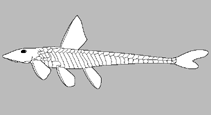
Spine dorsali (totale) : 1; Raggi dorsali molli (totale) : 8. Can be diagnosed from all other members of the genus Hypostomus, except the young specimens of Hypostomus latifrons, by having wide dark transverse bars on body and bands on the fins (vs. body entirely dark or with pale or dark spots); and by the conspicuous dark vermiculations on abdominal region (vs. abdominal region entirely dark or with pale or dark spots). Differs from Hypostomus latifrons by having the dark bars on the sides and bands on the fins in adults (vs. spots present anteriorly and dark blotches posteriorly in adults), and by having just one pre-dorsal plate margining the supraoccipital (vs. three plates) (Ref. 85849).
Body shape (shape guide): elongated.
Facultative air-breathing in the genus (Ref. 126274); Found in rio Cuiabá of the upper rio Paraguay basin characterized by turbid water, rocky with sand substrate, and variable remnant riparian vegetation. Occurs syntopically with Hypostomus boulengeri, H. cochliodon, H. latifrons, H. latirostris, H. regani and another putative undescribed species of Hypostomus (Ref. 85849).
Ciclo vitale e comportamento di accoppiamento
Maturità | Riproduzione | Deposizione | Uova | Fecondità | Larve
Zawadzki, C.H., C. Weber and C.S. Pavanelli, 2010. A new dark-saddled species of Hypostomus (Siluriformes: Loricariidae) from the upper rio Paraguay basin. Neotrop. Ichthyol. 8(4):719-725. (Ref. 85849)
Stato della Lista Rossa IUCN (Ref. 130435: Version 2025-2 (Global))
Minaccia per l'uomo
Harmless
Usi umani
Pesca: di nessun interesse
Strumenti
Rapporti speciali
Scarica XML
Fonti Internet
Stime basate su modelli
Indice di diversità filogenetica (Fonte Biblio.
82804): PD
50 = 0.5000 [Uniqueness, from 0.5 = low to 2.0 = high].
Bayesian length-weight: a=0.01585 (0.00726 - 0.03460), b=2.95 (2.78 - 3.12), in cm total length, based on LWR estimates for this Genus-body shape (Ref.
93245).
Resilienza (Fonte Biblio.
120179): Alto, tempo minimo di raddoppiamento della popolazione meno di 15 mesi (Preliminary K or Fecundity.).
Vulnerabilità della pesca (Ref.
59153): Low vulnerability (10 of 100).
🛈