Classificação / Nomes
Nomes comuns | Sinónimos | Catalog of Fishes(Género, Espécies) | ITIS | CoL | WoRMS | Cloffa
>
Siluriformes (Catfishes) >
Amphiliidae (Loach catfishes) > Doumeinae
Etymology: Doumea: Taken form a locality, Doumé, in Congo (Ref. 45335); reidi: The species name, reidi, honors Dr. Gordon McGregor Reid, of the North of England Zoological Society, who collected the holotype and who has dedicated a large portion of his career helping to protect, and improve our understanding of, wildlife and freshwater fishes worldwide (Ref. 85844).
Eponymy: Professor Dr Gordon McGregor Reid (d: 1948) is a British ichthyologist, zoologist and zoo director. [...] (Ref. 128868), visit book page.
More on authors: Ferraris, Skelton & Vari.
Ambiente: milieu / zona climática / intervalo de profundidade / gama de distribuição
Ecologia
; Água doce demersal. Tropical
Africa: upper Mbam River in eastern Nigeria, not far from border with Cameroon (Ref. 85844).
Tamanho / Peso / Idade
Maturidade: Lm ? range ? - ? cm
Max length : 9.3 cm SL macho/indeterminado; (Ref. 85844)
Descrição breve
Chaves de identificação | Morfologia | Morfometria
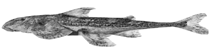
Espinhos dorsais (total) : 0; Raios dorsais moles (total) : 7; Espinhos anais: 0; Raios anais moles: 11. Diagnosis: Doumea reidi is distinguished from its congeners, except D. chappuisi and D. stilicauda, by having the dorsolateral and ventrolateral vertebral processes extending through the dermis to form longitudinal bony ridges from the base of the adipose fin posteriorly to the caudal-fin base and from slightly posterior of the anal-fin origin to the caudal-fin base; the exposed processes are in the shape of longitudinal bars with slightly corrugated surfaces that together form an irregular longitudinal ridge (Ref. 85844). Doumea reidi differs from differs from D. chappuisi in having caudal-peduncle length 31% of standard length, vs. 22-29%; the posterior extent of the adpressed pelvic fin in specimens over 90 mm extending distinctly beyond anterior limit of the anal fin, vs. falling short of that point; the anterior extent of the exposed vertebral processes along the ventral surface of the body extending to the area lateral to the anal-fin base, vs. extending to slightly posterior of pelvic-fin origin; and the pigmentation pattern of the dorsal surface of the unbranched rays of the pectoral and pelvic fins with a series of irregular dark spots against a lighter background, vs. uniformly pigmented (Ref. 85844). Doumea reidi differs from D. stilicauda in predorsal length 33% of standard length, vs. 27-30%; head length 18% of standard length, vs. 15-17%; caudal-peduncle length 31% of standard length, vs. 35-41%; and caudal-peduncle depth 11.8 times in caudal-peduncle length, vs. 19.6-25.8 times (Ref. 85844).
Body shape (shape guide): elongated.
The type locality of Doumea reidi is a cool, briskly flowing, upland stream less than 4 m wide and less than 1.5 m maximum depth; substratum was reported to consist of large, granitic boulders interspersed among deposits of coarse sand, mud, and leaf litter (Ref. 85844).
Ciclo de vida e comportamento de acasalamento
Maturidade | Reprodução | Desova | Ovos | Fecundidade | Larvas
Ferraris, C.J., P. Skelton and R.P. Vari, 2010. Species of the Doumea chappuisi complex (Siluriformes, Amphiliidae) with the descriptions of new species from the upper Sanaga River and Nyong River basins. Copeia 2010(4):705-715. (Ref. 85844)
Categoria na Lista Vermelha da IUCN (Ref. 130435: Version 2025-2 (Global))
Ameaça para o homem
Harmless
Utilização humana
Pescarias: sem interesse
Ferramentas
Relatórios especiais
Descarregue XML
Fontes da internet
Estimativas baseadas em modelos
Índice de diversidade filogenética (Ref.
82804): PD
50 = 0.5020 [Uniqueness, from 0.5 = low to 2.0 = high].
Bayesian length-weight: a=0.00389 (0.00180 - 0.00842), b=3.12 (2.94 - 3.30), in cm total length, based on all LWR estimates for this body shape (Ref.
93245).
Nível Trófico (Ref.
69278): 3.1 ±0.4 se; based on size and trophs of closest relatives
Vulnerabilidade da pesca (Ref.
59153): Low vulnerability (10 of 100).
🛈