Classificação / Nomes
Nomes comuns | Sinónimos | Catalog of Fishes(Género, Espécies) | ITIS | CoL | WoRMS | Cloffa
>
Scombriformes (Mackerels) >
Chiasmodontidae (Snaketooth fishes)
Etymology: Pseudoscopelus: Greek, pseudes = false + Greek, skopelos = a lantern fish (Ref. 45335). Lütken did not recognize the presence of photophores on the body, confusing them with pores, but referred to a genus of lanternfish (Scopelus now Myctophum) when he named the genus (Ref. 85782); paxtoni: Named for John Paxton, in recognition of his contributions to the knowledge of the deep-sea ichthyofauna, and all the support given to the development of this work.
Eponymy: Dr John Richard Paxton (d: 1938) is an American-born Australian ichthyologist. [...] (Ref. 128868), visit book page.
Taxonomic Remarks
This species is synonym ofPseudoscopelus altipinnis Parr, 1933 in Eschmeyer (CofF ver. Jan. 2012: Ref. 89336) following (Prokofiev, 2011). Waiting for the publication.
Ambiente: milieu / zona climática / intervalo de profundidade / gama de distribuição
Ecologia
marinhas batipelágico; intervalo de profundidade 893 - 1223 m (Ref. 85782). Deep-water
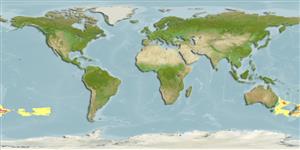
Southwest Pacific: Chatham Islands to west of New Zealand; from 173° W to 167° E, 39° to 48° S.
Tamanho / Peso / Idade
Maturidade: Lm ? range ? - ? cm
Max length : 22.8 cm SL macho/indeterminado; (Ref. 85782)
Descrição breve
Chaves de identificação | Morfologia | Morfometria
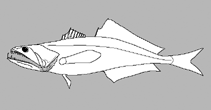
Espinhos dorsais (total) : 22 - 24; Raios anais moles: 21 - 23; Vértebras: 36 - 38. This species of the Pseudoscopelus altipinnis species group is distinct from P. altipinnis by dentition and photophore pattern: innermost teeth of mesial rows of premaxilla and dentary elongate, when mouth is closed and premaxilla is retracted reach the medial border of the contralateral premaxilla (vs. not extremely elongated and premaxilla is retracted teeth do not reach the medial border of premaxilla of the other side); teeth of mesial row of premaxilla and internal most row of dentary straight (vs. teeth of mesial row of premaxilla and internal-most row of dentary slightly curved); mesial series of premaxillary teeth arranged in transverse rows of one to three rows of teeth (vs. mesial series of premaxillary teeth arranged in transverse rows of one to five rows of teeth) (Ref. 85782).
Body shape (shape guide): elongated.
Meso- to bathypelagic, from 893 to 1223 m (mean 1027 m) (Ref. 85782).
Ciclo de vida e comportamento de acasalamento
Maturidade | Reprodução | Desova | Ovos | Fecundidade | Larvas
Melo, M.R.S., 2010. A revision of the genus Pseudoscopelus Lütken (Chiasmodontidae: Acanthomorphata) with descriptions of three new species. Zootaxa 2710:1-78. (Ref. 85782)
Categoria na Lista Vermelha da IUCN (Ref. 130435: Version 2025-2 (Global))
Ameaça para o homem
Harmless
Utilização humana
Ferramentas
Relatórios especiais
Descarregue XML
Fontes da internet
Estimativas baseadas em modelos
Temperatura preferida (Ref.
123201): 3.9 - 5.4, mean 4.1 °C (based on 6 cells).
Índice de diversidade filogenética (Ref.
82804): PD
50 = 0.5000 [Uniqueness, from 0.5 = low to 2.0 = high].
Bayesian length-weight: a=0.00389 (0.00180 - 0.00842), b=3.12 (2.94 - 3.30), in cm total length, based on all LWR estimates for this body shape (Ref.
93245).
Nível Trófico (Ref.
69278): 3.8 ±0.2 se; based on size and trophs of closest relatives
Vulnerabilidade da pesca (Ref.
59153): Low vulnerability (18 of 100).
🛈