वर्गीकरण / नाम
आम नाम | उपशब्द | Catalog of Fishes(वर्ग, प्रजाति) | ITIS | CoL | WoRMS | Cloffa
इलाज़मौबरांकी (शारक और रेज़) (sharks and rays) >
Rajiformes (Skates and rays) >
Gurgesiellidae (Pygmy skates)
Etymology: Cruriraja: Latin, crur, cruris = pertaining to a leg + Latin, raja = a ray (Raja sp) (Ref. 45335); hulleyi: Named for P.A. ‘‘Butch’’ Hulley, for his pioneering research on southern African skates.
Eponymy: Dr Percy Alexander ‘Butch’ Hulley (d: 1941) is a South African zoologist and ichthyologist. [...] (Ref. 128868), visit book page.
पर्यावरण: पर्यावरण / जलवायु क्षेत्र / गहराई सीमा / वितरण सीमा
पारिस्थितिकी
समुद्री बेनथोपिलाजिक; गहराई सीमा 39 - 545 m (Ref. 85323), usually 200 - 500 m (Ref. 85323). Subtropical
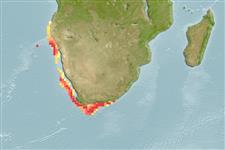
Southeast Atlantic: Lüderitz, Namibia to Algoa (and possibly East London) on the Eastern Cape coast of South Africa.
आकार / वज़न / आयु
परिपक्व अवधि: Lm ? range ? - ? cm
Max length : 58.0 cm TL पुल्लिंग / अलिंग; (Ref. 85323); 59.4 cm TL (female)
संक्षिप्त वर्णन
पहचान कुंजी | आकृति विज्ञान | मौरफोमैटरिक्स
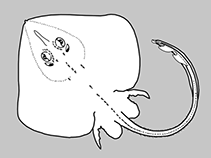
This species is distinct from its congeners in having the following characters: spatulate distal ends of the anterior pelvic lobes (wider tip in C. cadenati, tapering in others); dorsal mid-disk and tail with continuous semiparallel rows of thorns in adults (no thorns on mid-disk in C. rugosa, present on midline in others); claspers with small, flattened process (boss) on accessory terminal 2 cartilage and blind-ended sac with posterior opening at the distal end of the clasper (sentina), both unique within genus to C. hulleyi; interdorsal thorns 6 (none in C. durbanensis, 2 in C. parcomaculata, 4 in C. poeyi, 1 in C. rugosa, many in C. atlantis). This species is further distinguished from its congeners by the following set of characters: interdorsal distance greater than half, and not exceeding, dorsal-fin base length (vs. at least 1.5 times dorsal-fin base length in C. atlantis, half or less dorsal-fin base length in C. parcomaculata); outer lateral margin of clasper dorsal marginal cartilage elongated and bluntly rounded (truncate in C. rugosa); proximal margin of dorsal terminal I cartilage forms a point (a series of points in C. rugosa); distal point (eperon) of ventral terminal cartilage relatively narrow and claw-like (bifurcate in C. parcomaculata, expanded in C. rugosa); ventral surface of clasper without dermal denticles (present in C. parcomaculata) (Ref. .85323).
Body shape (shape guide): other.
Reported to be a moderately common species of the outer shelf and upper continental slope, 39-545 m deep, but most common between 200 and 500 depth. Larger individuals tend to occur on the west coast of southern Africa, while those on the south coast are slightly smaller. The egg case was described to be small, vase-like, measuring less than 50 mm long excluding horns, surface coarsely striated, and with very narrow lateral keels, <1% of maximum egg case width; its posterior horns are approximately 45% longer than the anterior horns, tapering to thin tips, curving inwards and with fine attachment fibers; the anterior horns are hook-shaped, with acute tips (Ref. 85323).
जीवन चक्र और संभोग व्यवहार
परिपक्व अवधि | पुनरुत्पत्ति | मछलीऔ का अंडे देना | अंडे | उपजाऊपन | लार्वा
Aschliman, N.C., D.A. Ebert and L.J.V. Compagno, 2010. A new legskate (Rajoidei: Genus Cruriraja) from Southern Africa. Copeia 2010(3):364-372. (Ref. 85323)
आईयूसीएन रेड लिस्ट स्थिति (Ref. 130435: Version 2025-2 (Global))
मनुष्यों के लिए ख़तरा
Harmless
मानव उपयोग
साधन
विशेष रिपोर्ट
XML डाउनलोड करें
इंटरनेट स्रोत
मॉडल पर आधारित अनुमान
पसंदीदा तापमान (संदर्भ
123201): 6.7 - 14, mean 9.5 °C (based on 54 cells).
जातिवृति विविधता सूचकांक (संदर्भ
82804): PD
50 = 0.5039 [Uniqueness, from 0.5 = low to 2.0 = high].
Bayesian length-weight: a=0.00661 (0.00227 - 0.01925), b=2.95 (2.71 - 3.19), in cm total length, based on LWR estimates for this (Sub)family-body shape (Ref.
93245).
ट्रॉफिक स्तर (संदर्भ
69278): 3.9 ±0.6 se; based on size and trophs of closest relatives
मछली पकड़ने की भेद्यता (Ref.
59153): Moderate vulnerability (44 of 100).
🛈