Klassifizierung / Names
Namen | Synonyme | Catalog of Fishes(Gattung, Arten) | ITIS | CoL | WoRMS | Cloffa
>
Lophiiformes (Anglerfishes) >
Himantolophidae (Footballfishes)
Etymology: Himantolophus: Greek, himas or himantos = leather strap, thong or leash (referring to the thick leathery illicium) + Greek, lopho or lophio = crest or tuft (referring to the baited illicium projecting from the head) (Ref. 86949); litoceras: Named for the lack of lateral branching or filamaents on the distal escal appendages; Greek 'litos' meaning simple or plain and 'keros' for 'horn'.
Umwelt: Milieu / Klimazone / Tiefenbereich / Verbreitungsgebiet
Ökologie
seewasser bathydemersal; tiefenbereich ? - 654 m (Ref. 85522). Subtropical
Southwest Pacific: New Zealand; expected to occur in the Tasman Sea.
Größe / Gewicht / Alter
Geschlechtsreife: Lm ? range ? - ? cm
Max length : 27.6 cm SL (female)
Kurzbeschreibung
Bestimmungsschlüssel | Morphologie | Morphometrie
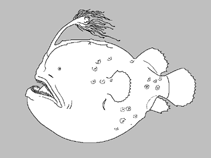
Rückenflossenweichstrahlen (insgesamt) : 5; Afterflossenweichstrahlen: 4. This species' metamorphosed females are distinct from other species of the H. cornifer group in having a pair of simple distal escal appendages, each without any trace of lateral appendages or filaments; further diagnosed by the following: illicium length 31.1% SL (28.2% preserved); escal bulb width 11.9% (10.5% preserved); no filaments in illicium and esca; tiny, close-set dermal spinules cover the illicium, esca and proximal one-half of distal escal appendage (this appendage is darkly pigmented, tip of intact filament silvery white in freshly thawed specimens) (Ref. 85522).
Body shape (shape guide): short and / or deep; Cross section: oval.
Lebenszyklus und Paarungsverhalten
Geschlechtsreife | Fortpflanzung | Ablaichen | Eier | Fruchtbarkeit | Larven
Stewart, A.L. and T.W. Pietsch, 2010. A new species of deep-sea anglerfish, genus Himantolophus (Lophiiformes: Himantolophidae) from the Western South Pacific, with comments on the validity of H. pseudalbinares. Zootaxa 2671:53-60. (Ref. 85522)
IUCN Rote Liste Status (Ref. 130435: Version 2025-2 (Global))
Bedrohung für Menschen
Harmless
Nutzung durch Menschen
Tools
Zusatzinformationen
Download XML
Internet Quellen
Schätzungen auf der Grundlage von Modellen
Phylogenetischer Diversitätsindex (Ref.
82804): PD
50 = 0.5000 [Uniqueness, from 0.5 = low to 2.0 = high].
Bayesian length-weight: a=0.01995 (0.00906 - 0.04395), b=3.01 (2.83 - 3.19), in cm total length, based on all LWR estimates for this body shape (Ref.
93245).
Trophische Ebene (Ref.
69278): 4.5 ±0.8 se; based on size and trophs of closest relatives
Anfälligkeit der Fischerei (Ref.
59153): Low vulnerability (24 of 100).
🛈