Klassifizierung / Names
Namen | Synonyme | Catalog of Fishes(Gattung, Arten) | ITIS | CoL | WoRMS | Cloffa
>
Cypriniformes (Carps) >
Psilorhynchidae (Mountain carps)
Etymology: Psilorhynchus: Greek, psilos = hairless + Greek, rhyngchos = snout (Ref. 45335); gokkyi: Named for Gokkyi, a small village above the type locality, to honor the hospitality and help extended to the second author during his collection trip in November 2009. A noun in apposition.
Eponymy: This is a toponym referring to Gokkyi, a small village above the type locality in Myanmar. The name was given to honour the hospitality and help extended to the second author during his collection trip (November 2009). (Ref. 128868), visit book page.
Umwelt: Milieu / Klimazone / Tiefenbereich / Verbreitungsgebiet
Ökologie
; süßwasser benthopelagisch. Tropical
Asia: Pani Chaung, Ayeyarwaddy River drainage in Myanmar.
Größe / Gewicht / Alter
Geschlechtsreife: Lm ? range ? - ? cm
Max length : 5.6 cm SL Männchen/unbestimmt; (Ref. 85329)
Kurzbeschreibung
Bestimmungsschlüssel | Morphologie | Morphometrie
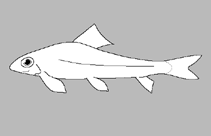
Rückenflossenweichstrahlen (insgesamt) : 12 - 13; Afterflossenweichstrahlen: 7 - 8; Wirbelzahl: 34. Distinguished from all its congeners by the possession of a deep notch situated at the level of the ethmoid region, visible as a square step-like division between the snout and the head in lateral view and a deep groove in dorsal view. Can be further diagnosed from other congeners by the following combination of characters: snout length 51-57% HL; ventral surface between paired fins with a broad triangular scale-less patch; dorsal fin with branched rays 9-10; pectoral fin with 5-6 unbranched rays; caudal fin with 10+9 rays; scales on lateral line 32-34; lateral sides of body marked with 6 indistinct round to squarish dark brown blotches, arranged in a longitudinal row; dorsal saddles deep, extending 3-4 scale rows downwards from dorsal surface, in contact with the round to squarish dark brown blotches, arranged in a longitudinal row on flank; caudal fin with an irregular pigmentation pattern, most prominent along lower lobe (Ref. 85329).
Body shape (shape guide): elongated.
Found in a swift-flowing stream with dense bank and overhanging vegetation, and a substrate of sand, gravel and small boulders (Ref. 85329).
Lebenszyklus und Paarungsverhalten
Geschlechtsreife | Fortpflanzung | Ablaichen | Eier | Fruchtbarkeit | Larven
Conway, K.W. and R. Britz, 2010. Three new species of Psilorhynchus from the Ayeyarwaddy River drainage, Myanmar (Teleostei: Psilorhynchidae). Zootaxa 2616:31-47. (Ref. 85329)
IUCN Rote Liste Status (Ref. 130435: Version 2025-2 (Global))
Bedrohung für Menschen
Harmless
Nutzung durch Menschen
Tools
Zusatzinformationen
Download XML
Internet Quellen
Schätzungen auf der Grundlage von Modellen
Phylogenetischer Diversitätsindex (Ref.
82804): PD
50 = 0.5000 [Uniqueness, from 0.5 = low to 2.0 = high].
Bayesian length-weight: a=0.00417 (0.00178 - 0.00974), b=3.16 (2.95 - 3.37), in cm total length, based on LWR estimates for this (Sub)family-body shape (Ref.
93245).
Trophische Ebene (Ref.
69278): 3.0 ±0.2 se; based on size and trophs of closest relatives
Anfälligkeit der Fischerei (Ref.
59153): Low vulnerability (10 of 100).
🛈