Classification / Noms
Noms communs | Synonymes | Catalog of Fishes(Genre, Espèce) | ITIS | CoL | WoRMS | Cloffa
>
Cypriniformes (Carps) >
Psilorhynchidae (Mountain carps)
Etymology: Psilorhynchus: Greek, psilos = hairless + Greek, rhyngchos = snout (Ref. 45335); brachyrhynchus: From the Greek words brachys (βραχυς), short, and rhynchos (ρυγχος), snout, in reference to the short snout of this species. An adjective.
Taxonomic Remarks
Psilorhynchus balitora illustrated by Mukerji 1933 (plate 1,2-4) is tentatively considered conspecific with Psilorhynchus brachyrhynchus, until more materials become available.
Environnement : milieu / zone climatique / profondeur / gamme de distribution
Écologie
; eau douce benthopélagique. Tropical
Asia: upper Ayeyarwaddy River drainage in northern Myanmar.
Taille / Poids / Âge
Maturité: Lm ? range ? - ? cm
Max length : 5.1 cm SL mâle / non sexé; (Ref. 85329)
Description synthétique
Clés d'identification | Morphologie | Morphométrie
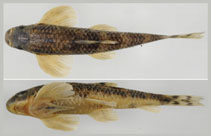
Rayons mous dorsaux (Total) : 12; Rayons mous anaux: 8; Vertèbres: 35. Distinguished from other species of the genus by the following combination of characters: short snout (snout length 43-48% HL); principal rays in the upper caudal-fin lobe 10; absence of a dark irregular vertical bar across the distal edge of the caudal fin; absence of a broad swath of melanophores across the anterior half of the dorsal fin; presence of a large dark blotch at the base of each caudal fin lobe; and presence of an irregular vertical bar across the center of the caudal fin. Can be further diagnosed from all congeners by the following combination of characters: 2 branchiostegal rays; ventral surface between paired fins with triangular scale-less patch; presence of a large postepiphysial fontanelle; branched dorsal-fin rays 9; unbranched pectoral-fin rays 5; caudal-fin rays 10+9; lateral-line scales 32-34; lateral sides of body marked with 5-7 indistinct round to squarish dark blotches, arranged in a longitudinal row; caudal fin with a dark, irregular vertical bar across its center (Ref. 85329).
Body shape (shape guide): elongated.
Cycle de vie et comportement reproducteur
Maturité | Reproduction | Frai | Œufs | Fécondité | Larves
Conway, K.W. and R. Britz, 2010. Three new species of Psilorhynchus from the Ayeyarwaddy River drainage, Myanmar (Teleostei: Psilorhynchidae). Zootaxa 2616:31-47. (Ref. 85329)
Statut dans la liste rouge de l'IUCN (Ref. 130435: Version 2025-2 (Global))
Menace pour l'homme
Harmless
Utilisations par l'homme
Outils
Articles particuliers
Télécharger en XML
Sources Internet
Estimations basées sur des modèles
Indice de diversité phylogénétique (Réf.
82804): PD
50 = 0.5000 [Uniqueness, from 0.5 = low to 2.0 = high].
Bayesian length-weight: a=0.00417 (0.00178 - 0.00974), b=3.16 (2.95 - 3.37), in cm total length, based on LWR estimates for this (Sub)family-body shape (Ref.
93245).
Niveau trophique (Réf.
69278): 3.0 ±0.2 se; based on size and trophs of closest relatives
Vulnérabilité de la pêche (Ref.
59153): Low vulnerability (10 of 100).
🛈