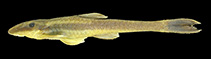
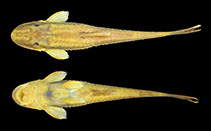
Classification / Noms
Noms communs | Synonymes | Catalog of Fishes(Genre, Espèce) | ITIS | CoL | WoRMS | Cloffa
>
Siluriformes (Catfishes) >
Loricariidae (Armored catfishes) > Hypoptopomatinae
Etymology: Microlepidogaster: Greek, mikros = small + Greek, lepis = scale + Greek, gaster = stomach (Ref. 45335); longicolla: The specific name longicolla is from the Latin longus (long) and collum (neck), meaning long-necked in allusion to the long predorsal region resulting from the posterior shift of the dorsal fin. An adjective.
More on authors: Calegari & Reis.
Environnement : milieu / zone climatique / profondeur / gamme de distribution
Écologie
; eau douce démersal. Tropical
South America: upper reaches of the rio São Bartolomeu, a tributary to the rio Corumbá, itself a tributary to the rio Paranaíba of the upper rio Paraná basin near Brasília in central Brazil.
Taille / Poids / Âge
Maturité: Lm ? range ? - ? cm
Max length : 4.6 cm SL mâle / non sexé; (Ref. 99822)
Description synthétique
Clés d'identification | Morphologie | Morphométrie
Épines dorsales (Total) : 2; Rayons mous dorsaux (Total) : 7; Rayons mous anaux: 6; Vertèbres: 31 - 33. Distinguished from Microlepidogaster perforatus, the only other species in this genus, by the possession of a continuous lateral line, median lateral plate series reaching, rather than falling short of, the end of the caudal peduncle, a shorter pectoral-fin spine (13.4-16.2 vs. 18.2-21.0% standard length), a smaller interorbital distance (38.9-43.1 vs. 47.7-53.3% head length), more numerous dentary teeth (16-29 vs. 12-15), the anterior margin of the snout naked (vs. the snout completely covered by plates), the preopercle not contacting the fourth postrostral plate (vs. the preopercle contacting and extending to midlength of that plate), the absence of the anterior processes of the supraneural (vs. supraneural bearing a bilateral pair of processes along its anterior margin), and the dorsal fin located more posteriorly relative to the parietosupraoccipital, where the neural spine of the tenth or eleventh vertebral centrum supports the compound supraneural plus first pterygiophore of the dorsal fin (vs. compound supraneural plus first pterygiophore supported by the neural spine of the eighth or ninth vertebra. Exhibits a remarkable suite of secondary sexually dimorphic characters, involving the presence of a conical urogenital papilla in males, the presence of a fleshy flap along the dorsal margin of first thickened pelvic-fin ray of males, longer pelvic fin in males, and a more strongly arched first pelvic-fin ray in females (Ref. 85171).
Body shape (shape guide): elongated.
Facultative air-breathing in the genus (Ref. 126274)
Cycle de vie et comportement reproducteur
Maturité | Reproduction | Frai | Œufs | Fécondité | Larves
Calegari, B.B. and R.E. Reis, 2010. A new species of Microlepidogaster (Siluriformes: Loricariidae: Hypoptopomatinae) from the upper rio Paraná basin, Brazil. Neotrop. Ichthyol. 8(3):625-630. (Ref. 85171)
Statut dans la liste rouge de l'IUCN (Ref. 130435: Version 2025-2 (Global))
Menace pour l'homme
Harmless
Utilisations par l'homme
Outils
Articles particuliers
Télécharger en XML
Sources Internet
Estimations basées sur des modèles
Indice de diversité phylogénétique (Réf.
82804): PD
50 = 0.5039 [Uniqueness, from 0.5 = low to 2.0 = high].
Bayesian length-weight: a=0.00977 (0.00434 - 0.02202), b=3.06 (2.87 - 3.25), in cm total length, based on LWR estimates for this (Sub)family-body shape (Ref.
93245).
Vulnérabilité de la pêche (Ref.
59153): Low vulnerability (10 of 100).
🛈