>
Tetraodontiformes (Puffers and filefishes) >
Tetraodontidae (Puffers) > Canthigasterinae
Etymology: Canthigaster: Greek, kanthos = the outer or inner corner of the eye, where the lids meet, 1646 + Greek, gaster = stomach (Ref. 45335).
Eponymy: Daniel Carl [Karl] Solander (1733–1782) was a Swedish naturalist and explorer who was one of Linnaeus’s pupils at Uppsala. [...] (Ref. 128868), visit book page.
More on author: Richardson.
Taxonomic Remarks
Occurrence of this species need to be reviewed.
Environnement : milieu / zone climatique / profondeur / gamme de distribution
Écologie
marin récifal; non migrateur (Ref. 52884); profondeur 10 - 36 m (Ref. 1602). Tropical; 30°N - 24°S
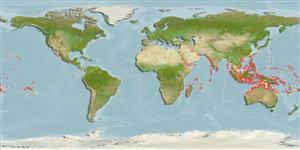
Central Pacific, including Hawaiian Islands. Indian Ocean species were re-identified as Canthigaster petersii (Ref. 123151).
Population from the Philippines, Indonesia, New Guinea, Queensland, and Belau differs in coloration (formerly Canthigaster papua);
Replaced by Canthigaster margaritata in the Red Sea.
Taille / Poids / Âge
Maturité: Lm ? range ? - ? cm
Max length : 12.1 cm TL mâle / non sexé; (Ref. 126022); poids max. publié: 32.16 g (Ref. 126022)
Description synthétique
Clés d'identification | Morphologie | Morphométrie
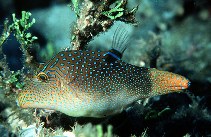
Épines dorsales (Total) : 0; Rayons mous dorsaux (Total) : 8 - 10; Épines anales: 0; Rayons mous anaux: 8 - 10. Ocellus at base of dorsal fin; dark lines radiating from eye; caudal fin brown with pale spots, outer rows may form wavy lines (Ref. 4919).
Body shape (shape guide): short and / or deep.
Adults inhabit sheltered rocky reefs (Ref. 48637). Also live in intertidal reef flats, lagoon and seaward reefs. They occur over open barren areas, also among corals and under ledges (Ref. 9710). Benthopelagic (Ref. 58302). Often found in pairs, sometimes in small groups. Adults feed mainly on filamentous red and green algae and coralline red algae but also on corals, tunicates, mollusks, echinoderms, polychaetes, crustaceans and bryozoans. Common (Ref. 9710). Monogamous (Ref. 52884).
Cycle de vie et comportement reproducteur
Maturité | Reproduction | Frai | Œufs | Fécondité | Larves
Oviparous (Ref. 205). Displays facultative monogamy where males are constrained to mate with a single female due to resource limitation (Ref. 52884).
Matsuura, K., S.V. Bogorodsky, A.O. Mal and T.J. Alpermann, 2020. Canthigaster aziz, a new deep-dwelling toby fish (Tetraodontiformes: Tetraodontidae) from the Red Sea. Zootaxa 4834(1):81-95. (Ref. 123151)
Statut dans la liste rouge de l'IUCN (Ref. 130435: Version 2025-2 (Global))
Menace pour l'homme
Harmless
Utilisations par l'homme
Pêcheries: commercial; Aquarium: Commercial
Outils
Articles particuliers
Télécharger en XML
Sources Internet
Estimations basées sur des modèles
Température préférée (Réf.
123201): 26.1 - 29, mean 28 °C (based on 454 cells).
Indice de diversité phylogénétique (Réf.
82804): PD
50 = 0.5000 [Uniqueness, from 0.5 = low to 2.0 = high].
Bayesian length-weight: a=0.03162 (0.01865 - 0.05362), b=2.84 (2.69 - 2.99), in cm total length, based on LWR estimates for this species & Genus-body shape (Ref.
93245).
Niveau trophique (Réf.
69278): 3.6 ±0.23 se; based on food items.
Résilience (Réf.
120179): Haut, temps minimum de doublement de population inférieur à 15 mois (Preliminary K or Fecundity.).
Vulnérabilité de la pêche (Ref.
59153): Low vulnerability (10 of 100).
🛈
Nutriments (Ref.
124155): Calcium = 110 [51, 262] mg/100g; Iron = 1.02 [0.49, 2.36] mg/100g; Protein = 18.1 [15.8, 20.2] %; Omega3 = 0.127 [0.061, 0.255] g/100g; Selenium = 35.6 [16.8, 79.4] μg/100g; VitaminA = 50.2 [13.8, 194.7] μg/100g; Zinc = 1.75 [1.11, 2.63] mg/100g (wet weight);